
Quick answer: power bank with a socket
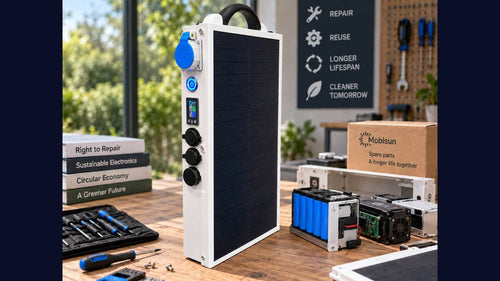
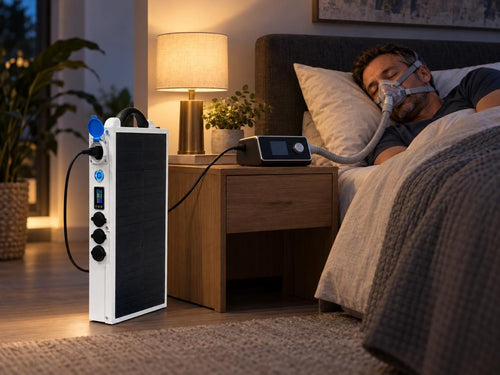
A power bank with a real socket is called a power station. For a laptop or working day out, the Mobisun Pro Air (154Wh, 4.3 kg, 300W) is enough. For a fridge, CPAP or several devices up to 500W, choose the Pro Air 2.0 (308Wh, 6.8 kg, IP67). Both deliver pure sine wave 230V, which ordinary USB power banks (max 100W) cannot. All Mobisun models can be recharged with foldable solar panels.
| Your need | Solution | Mobisun model |
|---|---|---|
| Phone/tablet on the go | USB-C up to 100W | regular power bank |
| Laptop + monitor for a day | 300W continuous | Pro Air 154Wh |
| Fridge, CPAP, TV + solar charging | 500W continuous, IP67 | Pro Air 2.0 308Wh |
| Household tools, construction | 1800W, on wheels | PSG1800 3000Wh |
You know power banks for your phone. But does a power bank with a wall socket exist, one you can plug your laptop, cooler or even power tools into? Yes. In this guide we explain what it is, how to choose the right one and how it differs from what manufacturers call a "power station".
A power bank with wall socket is a portable battery with a built-in 230V outlet, usually complemented by USB and 12V ports, so you can also power devices with a regular plug, anywhere. Officially these devices are often called a power station or portable solar generator, but they do exactly what the name promises: a power bank, but with a socket.
The difference with a regular power bank is big:
| Power bank (phone) | Power bank with wall socket | |
|---|---|---|
| Voltage | 5-20V (USB only) | 230V AC, often also USB and 12V |
| Capacity | 5,000-30,000 mAh (approx. 20-110 Wh) | 150-300+ Wh |
| Devices | phone, earbuds | laptop, cooler, lighting, TV, power tools |
What can you plug into it?
That is determined by the continuous output: how many watts the device can deliver. A laptop needs 60-100W, a camping cooler 40-60W, power tools briefly 300-600W. Always look at two numbers: the continuous output (for prolonged use) and the peak output (for starting motors, compressors and pumps). Such a startup surge is short but can be considerably higher than the continuous output.
Important
A kettle or microwave draws far more than 500W and will not run on a compact power station. Check the continuous output of your appliance before connecting it.
Capacity: look at Wh, not mAh
Manufacturers of small power banks count in mAh, but for 230V devices Wh (watt-hours) says much more. Wh indicates how much energy the battery can store. For comparison: a 20,000 mAh phone power bank contains roughly 74 Wh; the Mobisun Pro Air 2.0 contains 308 Wh, more than four times as much. Read more in our explanation of mAh and Wh.
Formula
Want to convert yourself? Wh = (mAh x voltage) / 1000. A 20,000 mAh power bank at 3.7V holds about 74 Wh.
What to look for when buying
- Continuous + peak output. If you want to run a cooler and also use devices with a startup surge (compressor, pump, power tools), choose a high continuous output.
- Pure sine wave inverter. Recommended for laptops and sensitive electronics.
- Battery type. LiFePO4 lasts 3,000+ charge cycles (approx. 8 years) and is safer than older battery types.
- Protection rating. For outdoor use you want at least IP54 (splash-proof); IP67 means dust-tight and resistant to temporary immersion.
- Repairability. Most power stations are throwaway products; choose one with replaceable parts.
The Mobisun approach: a power bank with solar panel
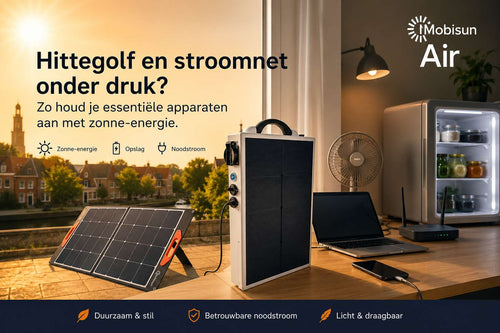
What makes Mobisun special: the Pro line has a solar panel integrated. The power bank charges itself as soon as there is sun, without you having to do anything. Handy for charging on the go, and if you want to charge faster, you can connect a separate foldable solar panel from 60 to 100W to any model. Read everything about this category in our guide about the power station with integrated solar panel.

Which Mobisun suits you?
| Pro Air | Pro Air 2.0 | |
|---|---|---|
| Output | 300W continuous | 500W continuous (1000W peak) |
| Capacity | 154 Wh | 308 Wh (LiFePO4) |
| Charging | via adapter | via USB-C or adapter |
| Solar panel | 29W SunPower, integrated | 23W SunPower, integrated |
| Protection | IP54, splash-proof | IP67, dust-tight and resistant to temporary immersion |
| Weight | 4.3 kg | 6 kg |
| Ideal for | day trips, festivals, light camping | camper, off-grid, backup power at home, work |
Doubting between the two? Choose the Mobisun Pro Air if you want a low weight and mainly charge phone, tablet or laptop on the go. Choose the Mobisun Pro Air 2.0 if you need more power and capacity, for example for a cooler, for work on location or as backup power for lighting, router and laptops at home.
Recommended: Mobisun Pro Air 2.0
Need a wall socket, maximum capacity and IP67 protection in one device? The Pro Air 2.0 combines 308 Wh with a 500W inverter and an integrated solar panel, designed and produced in the Netherlands.
Both are designed and produced in the Netherlands, fully repairable (screwed, no glue) and come with a 1-year factory warranty. View the complete range of power stations or contact us for advice.
Can a 230V power bank go on a plane?
In most cases: no. Batteries up to 100 Wh are allowed in hand luggage. Between 100 and 160 Wh the IATA 2026 rules apply a ban (some airlines make an exception under conditions), and above 160 Wh transport as passenger baggage is not allowed. In concrete terms: the Mobisun Pro Air (154 Wh) and Pro Air 2.0 (308 Wh) therefore cannot travel on a plane. You can read all the rules in our guide about power banks and power stations on a plane.
Frequently asked questions
Can I use a power bank with wall socket indoors?
Yes, provided the device is undamaged and used according to the manual. There are no exhaust gases, so indoor use is safe, including as backup power during an outage for lighting, your router or a laptop.
How long does the battery of a power bank with wall socket last?
The LiFePO4 battery of the Mobisun Pro Air 2.0 lasts 3,000+ charge cycles, roughly 8 years with daily use.
Can I use a power bank with wall socket while it is charging?
This differs per model and brand; check the specifications and manual of the device.
Choose the right power bank with wall socket
A wall socket on a portable battery means freedom: work, cool and stay online anywhere. The Mobisun Pro line combines a 230V outlet with an integrated solar panel, designed and produced in the Netherlands.
View power stations