
TELECOM & 5G
Telecom and 5G: uninterrupted power supply for cell towers
A telecom network is only available as long as the energy supply continues to function. In locations with an unstable electricity grid, without a grid connection or with prolonged power outages, a reliable combination of solar energy, battery storage, monitoring and backup power is therefore needed.
Mobisun’s large energy systems provide local power for mobile cell towers, 4G and 5G installations, temporary communication points, microwave links and other telecom infrastructure.
Choose a mobile Solar Trailer for temporary or relocatable applications, a 20ft Solar Container for a fixed telecom site or a 40ft Solar Container for larger locations, multiple operators and complete microgrids.
Reliable power is the foundation of network availability
Cell towers and base stations must be able to function day and night. The electricity demand depends on, among other things, the number of radio units, frequencies used, backhaul equipment, cooling, site sharing and the required coverage.
For telecom operators and towerco’s, the following situations in particular pose a challenge:
- locations without electricity grid
- areas with regular grid outages
- remote tower locations
- temporary capacity expansions
- new towers still waiting for a grid connection
- emergency networks after storm, flood or other disasters
- locations where diesel transport is expensive or difficult
- towers shared by multiple operators
GSMA describes reliable and affordable energy as an important condition for continuous mobile connectivity. At off-grid and weak-grid locations, combinations of renewable energy, battery storage, generator backup and remote monitoring are therefore increasingly used.
From diesel-driven location to hybrid telecom energy
Traditional off-grid cell towers are often dependent on diesel generators. This requires fuel transport, periodic maintenance, filters, spare parts and site visits.
A Mobisun system uses solar energy and battery storage as its central energy source. A generator can remain available for longer periods with insufficient sun, exceptionally high consumption or additional redundancy.
This is how the hybrid energy supply works
- The solar panels produce electricity during the day.
- The energy is used directly by the telecom equipment.
- Excess energy is stored in the battery.
- The battery feeds the installation during the night and with little sun.
- The backup generator supports the system when the set energy reserve is reached.
- Remote monitoring provides insight into production, consumption, battery level and system status.
As a result, the generator does not have to run continuously. The actual reduction in generator hours depends on the energy profile, solar irradiation, season, battery reserve and the chosen redundancy.
GSMA mentions battery storage, renewable energy and remote energy management as important tools to reduce dependence on diesel and manage telecom sites more efficiently.
Applications for telecom operators and towerco’s
Six common applications where the Mobisun systems directly add value for telecom infrastructure.
Off-grid cell towers
In locations where connection to the electricity grid is not technically or financially feasible, a Solar Trailer or Solar Container can form an independent local power plant.
Weak-grid and brownfield locations
An existing grid connection does not always offer sufficient operational certainty either. A Mobisun system can be used as an additional energy source and battery buffer in case of:
- recurring power outages
- voltage problems
- limited connection capacity
- an expansion of the radio equipment
- a temporary increase in network capacity
Temporary mobile cell towers
During events, maintenance work, network migrations or calamities, temporary additional telecom capacity may be needed.
Emergency response and connectivity restoration
After a natural disaster or major outage, local communication may be necessary while the normal infrastructure is damaged or overloaded. A mobile power plant can supply power to:
- mobile cell towers
- temporary base stations
- satellite and backhaul systems
- communication containers
- command posts
- routers and network equipment
- lighting and technical support
Shared telecom sites
At a location with multiple operators, one central energy supply can support different technical installations. Such a design requires separate energy metering, distribution, protection and availability agreements.
Microgrids around a cell tower
A telecom site can act as a stable base load within a local microgrid. In addition to the tower, a larger energy system can optionally also support selected local facilities, provided sufficient power, storage and distribution capacity are designed for this.
The three Mobisun systems for telecom
From a mobile Solar Trailer for temporary projects to the 40ft Solar Container for large multi-operator sites — discover which Mobisun system suits your telecom location.
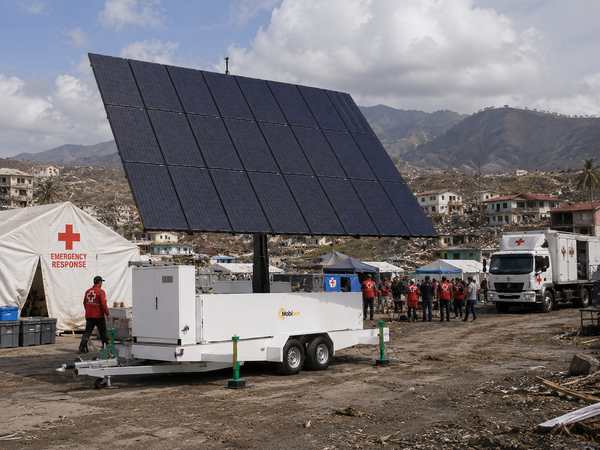
Mobisun Solar Trailer
Mobile solar energy for temporary and relocatable cell towers
20kWh battery · 8kWp solar panels · 7kVA AC outputThe Mobisun Solar Trailer is a mobile power plant for telecom projects that need to be operational quickly or regularly change location. The solar panel field has a set-up area of approximately 30m² and uses solar tracking. This automatically moves the panels towards the sun. Mobisun reports a possible yield improvement of up to 25% compared to a fixed setup. The trailer features 20kWh battery storage, 7kVA output power and a 10kVA backup generator. Remote monitoring and control enable remote monitoring and management.
Specifications Solar Trailer
- Battery storage: 20kWh
- Solar power: 8kWp
- Solar panel area: approximately 30m²
- AC output: 7kVA
- Backup generator: 10kVA
- 230V connection: single phase, 16A
- 400V connection: three phase, 10A
- Solar tracking: yes, up to 25% additional yield
- Monitoring: remote monitoring & control
- Protection class: IP54
- Setup: approximately 10 minutes by one person
- Weight: approximately 3.5 tons
Suitable for
- temporary cell towers
- cell-on-wheels installations
- maintenance and network upgrades
- emergency communication
- temporary backup during replacement of the existing energy supply
- pilot projects for solar energy at telecom sites
- locations that change regularly
Main advantage
The Solar Trailer combines mobility and quick commissioning. This allows the same power plant to be deployed consecutively at different telecom locations.
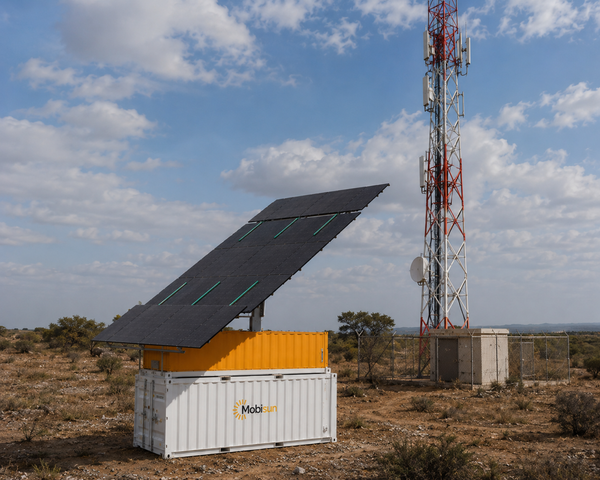
Mobisun 20ft Solar Container
Permanent off-grid energy for cell towers and telecom sites
50kWh battery · 13.3kWp solar panels · 22kVA AC outputThe 20ft Solar Container is intended for telecom sites that need more battery capacity and output power than the mobile trailer can deliver. The system combines 50kWh storage with 13.3kWp solar panels on a field of approximately 60m². The 22kVA AC output and 63A three-phase connection provide space for a central telecom installation and additional site facilities, depending on the calculated load profile. A 20kVA backup generator can support the installation in case of insufficient solar production or a prolonged increased energy demand. Performance and system status can be tracked via remote monitoring.
Specifications 20ft Solar Container
- Battery storage: 50kWh
- Solar power: 13.3kWp
- Solar panel area: approximately 60m²
- AC output: 22kVA
- Backup generator: 20kVA
- 230V connection: single phase, 16A
- 400V connection: three phase, 63A
- Solar tracking: yes, up to 25% additional yield
- Monitoring: remote monitoring & control
- Setup: approximately 30 minutes by one person
- Weight: approximately 20 tons
Suitable for
- permanent off-grid cell towers
- locations with a weak or unstable electricity grid
- shared telecom sites
- 4G and 5G infrastructure
- network equipment with additional cooling
- regional communication hubs
- telecom installations within a local microgrid
- locations where generator hours must be drastically reduced
Main advantage
The 20ft Container offers a strong balance between solar power, battery capacity, transportability and central power supply. For many medium-sized telecom sites, this will be the most logical starting point for a project-specific calculation.
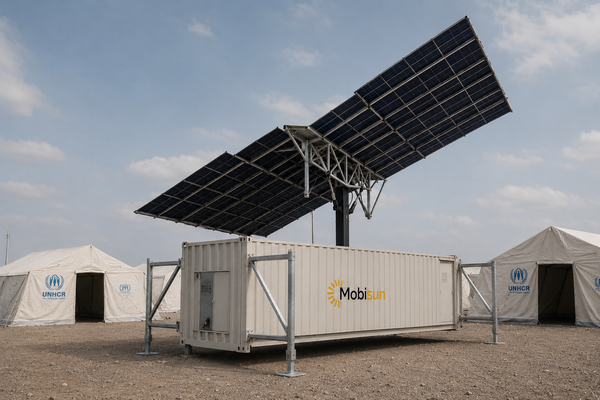
Mobisun 40ft Solar Container
Maximum capacity for critical telecom infrastructure
100kWh battery · 37.4kWp solar panels · 44kVA AC outputThe Mobisun 40ft Solar Container is Mobisun’s largest current energy system. The system is intended for locations with a high continuous load, multiple technical installations or a larger desired energy reserve. The installation combines 100kWh battery storage with 37.4kWp solar panels on a set-up area of approximately 170m². The maximum AC output power is 44kVA. A 40kVA backup generator can be deployed as an additional energy source. Remote monitoring provides remote insight into solar production, energy consumption and system status.
Specifications 40ft Solar Container
- Battery storage: 100kWh
- Solar power: 37.4kWp
- Solar panel area: approximately 170m²
- AC output: 44kVA
- Backup generator: 40kVA
- 230V connection: single phase, 16A
- 400V connection: three phase, 63A
- Solar tracking: yes, up to 25% additional yield
- Monitoring: remote monitoring & control
- Setup: approximately 30 minutes by one person
- Weight: approximately 27 tons
Suitable for
- large cell tower locations
- multiple operators on one site
- regional telecom hubs
- critical communication infrastructure
- larger cooling and technical installations
- off-grid 4G and 5G networks
- complete microgrids
- locations with a high continuous energy demand
- projects for which additional battery reserve is necessary
Main advantage
The 40ft Container offers the largest combination of solar production, storage and output power. This makes the system suitable for larger energy profiles and for locations where multiple telecom and supporting systems are centrally powered.
Compare the Mobisun solutions for telecom
An overview of the three large Mobisun systems based on the current product specifications. All three systems support solar tracking and remote monitoring.
| System | Battery | Solar power | AC output | Generator | Setup | Recommended telecom application |
|---|---|---|---|---|---|---|
| Solar Trailer | 20kWh | 8kWp | 7kVA | 10kVA | Approx. 10 min. | Temporary or mobile cell tower |
| 20ft Solar Container | 50kWh | 13.3kWp | 22kVA | 20kVA | Approx. 30 min. | Permanent off-grid telecom site |
| 40ft Solar Container | 100kWh | 37.4kWp | 44kVA | 40kVA | Approx. 30 min. | Large site, multi-operator or microgrid |
The Solar Trailer has 230V single phase 16A and 400V three phase 10A; both containers have 230V single phase 16A and 400V three phase 63A.
Which system does your cell tower need?
A telecom site should not be dimensioned exclusively on peak power. For a reliable solution, continuous consumption and desired autonomy are particularly decisive.
Map at least the following data
- average continuous consumption in kW
- maximum power and possible inrush peaks
- operating duration: usually 24 hours per day
- desired autonomy without sun or mains power
- local solar irradiation and seasonal differences
- availability and quality of the electricity grid
- existing generator and fuel supply
- radio, backhaul and network equipment
- cooling and ventilation
- tower lighting and security
- current and future network capacity
- number of operators at the location
- desired redundancy
- required AC and DC voltages
Indicative battery autonomy without solar production
The values below are simple theoretical calculations based on the nominal battery capacity. They do not yet take into account conversion loss, minimum battery reserve, temperature, aging or other system loads.
| Average load | Daily consumption | Solar Trailer 20kWh | 20ft Container 50kWh | 40ft Container 100kWh |
|---|---|---|---|---|
| 1kW | 24kWh | Maximum approx. 20 hours | Maximum approx. 50 hours | Maximum approx. 100 hours |
| 2.5kW | 60kWh | Maximum approx. 8 hours | Maximum approx. 20 hours | Maximum approx. 40 hours |
| 5kW | 120kWh | Maximum approx. 4 hours | Maximum approx. 10 hours | Maximum approx. 20 hours |
The table also shows why a telecom system cannot be selected solely on battery capacity. For 24/7 operation, daily solar production, generator strategy and local conditions are at least as important.
Use the Mobisun calculator for an initial system choice
The calculator on Mobisun.com takes into account:
- average power consumption in kW
- operating duration of 8, 12, 24 or 48 hours
- season
- expected solar yield
- battery capacity
- possible use of a generator
The calculator currently uses approximately seven effective sun hours in summer, 4.5 hours in spring and autumn, two hours in winter and 0.8 hours in cloudy weather. The result shows, among other things, the expected energy production, battery duration and required generator support.
Recommended telecom setting
- Application: Telecom site or cell tower
- Average load: freely adjustable in kW
- Operating duration: 24 hours
- Autonomy: 12, 24, 48 or 72 hours
- Grid status: off-grid, weak-grid or on-grid with emergency power
- Season and location: manually selectable
- Generator: present, optional or not allowed
- Redundancy: standard, N+1 or project-specific
- Output: AC or telecom DC via additional power supply
Then show three scenarios
- battery autonomy without solar production
- expected contribution from the solar panels
- required generator hours in unfavorable conditions
AC and 48V DC integration
Many telecom installations internally work with a DC grid, often via rectifiers, battery cabinets and DC distribution. The current Mobisun product pages mainly specify 230V and 400V AC outputs for the three large systems.
When the cell tower needs a specific DC power supply, the following components must be included in the project design:
- suitable AC/DC rectifiers
- telecom DC distribution
- surge protection
- fuses and selectivity
- earthing and lightning protection
- automatic switchover
- existing backup batteries
- communication between the energy system and the network management system
Remote monitoring for fewer site visits
Remote telecom sites are expensive to inspect. Remote monitoring makes it possible to detect performance and deviations earlier.
With the monitoring of the large Mobisun systems, the following data can, among other things, be included in a project dashboard:
- current solar production
- energy consumption
- battery status
- charge and discharge power
- generator status
- system messages
- historical energy data
- available autonomy
Mobisun mentions remote monitoring and control as a standard feature on the Solar Trailer and both Solar Containers. GSMA also emphasizes that remote energy management helps operators to better assess energy efficiency and operational performance.
For telecom projects, it can be investigated whether alarms and key data can be linked to the existing NOC or network management platform.
Benefits for telecom operators and towerco’s
Less dependence on diesel
Solar panels and battery storage take over a larger share of the daily energy supply. The generator remains available for exceptional circumstances and redundancy.
Higher availability in remote locations
An independent energy system makes new cell tower locations possible where a traditional grid connection is missing or takes a long time.
Lower local noise pollution
During operation from sun and battery, no running combustion engine is needed. This is relevant for towers near homes, resorts, nature reserves and temporary event locations.
Remote insight into performance
Operators gain insight into energy generation, consumption, battery status and any support by the generator.
Scalable infrastructure
Mobisun offers three capacity levels, from a mobile 20kWh trailer to a 100kWh infrastructure container.
Temporary and permanent use
The Solar Trailer focuses on mobile and temporary projects. The containers are intended for long-term off-grid infrastructure, telecom and microgrids.
Rental, lease or purchase
The Solar Trailer is offered on Mobisun.com for short and long term rental, lease and purchase. For the containers, a project-specific quote is prepared.
Practical telecom configurations
Three typical configurations for telecom projects, from a temporary mobile tower to a large multi-operator site.
Temporary mobile tower
Recommended starting point
- Mobisun Solar Trailer
- 20kWh battery
- 8kWp solar tracking
- 10kVA backup generator
- remote monitoring
- project-specific AC/DC power supply
Suitable for
- events
- temporary maintenance
- network expansion
- emergencies
- replacement of an existing energy set
Permanent rural cell tower
Recommended starting point
- Mobisun 20ft Solar Container
- 50kWh battery
- 13.3kWp solar panels
- 20kVA backup generator
- remote monitoring
- telecom rectifier and DC distribution
- sufficient reserve for bad weather
Suitable for
- off-grid tower location
- weak-grid area
- 4G or 5G base station
- shared site with limited load
- location with structural grid outages
Large multi-operator telecom site
Recommended starting point
- Mobisun 40ft Solar Container
- 100kWh battery
- 37.4kWp solar panels
- 40kVA backup generator
- separate energy distribution and metering
- remote monitoring
- additional redundancy
Suitable for
- multiple operators
- regional communication hub
- extensive cooling installation
- larger backhaul configuration
- local microgrid
- critical infrastructure
The final configuration must always be based on measured load and a project-specific reliability analysis.
From site survey to operational energy system
1. Inventory
Mobisun collects information about the location, the consumption profile, the existing energy supply, the available space and the desired availability.
2. Measurement of the energy profile
For an existing tower, an actual load measurement is preferred over exclusively nominal powers of equipment.
3. Design and simulation
Battery capacity, solar panel power, generator strategy and seasonal influences are calculated.
4. Technical project proposal
The proposal contains the system choice, connections, monitoring, distribution, safety facilities and optional service.
5. Production and delivery
Mobisun states a production time of approximately four to twelve weeks for B2B projects, depending on complexity.
6. Installation and commissioning
The system is placed, connected and tested with the actual telecom load.
7. Monitoring and maintenance
Optional service contracts can include monitoring, preventive maintenance and support. Warranty terms for the B2B systems are specified per project and contract.
Frequently asked questions about power supply for cell towers
Which Mobisun system is suitable for a cell tower?
The Solar Trailer is particularly suitable for temporary and mobile towers. The 20ft Container is a logical starting point for a permanent medium-sized telecom site. The 40ft Container is intended for larger energy profiles, multi-operator locations and microgrids. The right choice is ultimately determined by the continuous consumption, desired autonomy and local solar yield.
Can a cell tower run entirely on solar energy?
This is possible when the energy consumption, solar yield and battery capacity are well matched. For periods with little sun, more storage or generator backup may be needed.
Do the systems supply power 24 hours a day?
The systems are intended for continuous energy supply, but the achievable autonomy depends on load, solar irradiation, battery reserve and generator strategy. For guaranteed availability, a project-specific redundant design must be made.
Is a backup generator necessary?
Not always. With sufficient solar production and battery capacity, the site can operate for long periods without a generator. A generator does provide additional operational certainty during bad weather, maintenance or exceptional load.
Can the generator start automatically?
The large systems can work with a generator to increase autonomy and charge the battery. The desired automatic start logic and switchover must be recorded in the technical project design.
Can the systems power a 48V telecom installation?
According to the current product specifications, the large systems supply 230V and 400V AC. For a telecom installation with a DC bus, a suitable rectifier and DC distribution are required.
Can the energy supply be monitored remotely?
Yes. The Solar Trailer, 20ft Container and 40ft Container feature remote monitoring and control.
Do the solar panels work in cloudy conditions?
Yes, but with a lower yield. The Mobisun calculator uses approximately 0.8 effective sun hours for cloudy conditions, compared to approximately seven hours in summer.
Are the systems suitable for outdoor use?
Mobisun states an IP54 protection class for the large systems. The final placement, cabling, earthing and protection must meet the requirements for the specific location.
How quickly are the systems operational?
According to Mobisun, the Solar Trailer can be set up in approximately ten minutes by one person. For the 20ft and 40ft Containers, approximately thirty minutes is mentioned.
Can one system power multiple operators?
This may be technically possible when power, energy distribution, metering, protection and contractual availability are designed for this. Separate groups and energy meters can be included for each operator.
Keep your network accessible, even outside the electricity grid
Telecom infrastructure requires energy that is available day and night. With the Mobisun Solar Trailer and Solar Containers you combine local solar production, battery storage, remote monitoring and generator backup in one scalable solution.
From a temporary cell tower to a permanent multi-operator location: Mobisun helps you align the energy supply with actual consumption and desired operational certainty.