
When comparing power banks, one of the first specifications you will see is a number such as 5,000 mAh, 10,000 mAh or 20,000 mAh. But what does mAh mean on a power bank, and how much usable energy do you actually get?
mAh stands for milliampere-hour. It indicates how much electrical charge a battery can store. In general, a power bank with a higher mAh rating can power your devices for longer or recharge them more often.
However, mAh does not tell you everything. Voltage, energy conversion losses, charging speed and the power requirements of your device also determine how useful a power bank will be.
What Does mAh Mean?
The abbreviation mAh stands for milliampere-hour, not "milliamps per hour". It is a measurement of electrical charge commonly used for batteries in smartphones, tablets, power banks and other portable devices.
One ampere-hour equals 1,000 milliampere-hours:
- 1 Ah = 1,000 mAh
- 5 Ah = 5,000 mAh
- 10 Ah = 10,000 mAh
In theory, a 10,000 mAh battery could supply:
- 10,000 mA for one hour;
- 1,000 mA for ten hours;
- 500 mA for twenty hours.
These are theoretical examples. The actual runtime depends on battery voltage, device efficiency, temperature and the amount of power being drawn.
Does a Higher mAh Rating Mean a Better Power Bank?
A higher mAh rating usually means that the battery stores more charge. This can be useful when you want to:
- recharge your smartphone several times;
- charge multiple devices;
- stay powered during a weekend trip;
- use a power bank while camping or travelling;
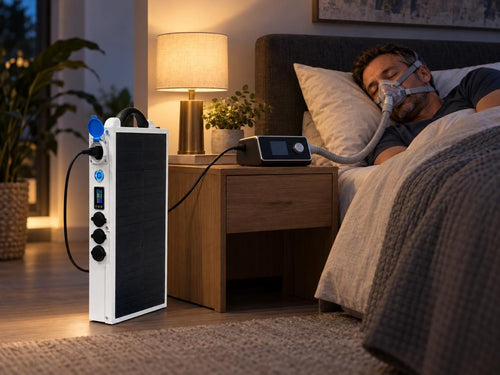
- keep essential devices running during a power outage.
But more mAh also usually means a larger and heavier battery. The best power bank is therefore not automatically the one with the highest capacity. It is the model that offers the right balance between capacity, weight, output power and portability.
Important
mAh does not indicate charging speed. Charging speed is mainly determined by the output in watts and by charging technologies such as USB-C Power Delivery.
What Is the Difference Between mAh and Wh?
mAh measures electrical charge, while watt-hours — or Wh — measure the actual amount of energy stored in a battery.
Wh is particularly useful when comparing batteries with different voltages. The formula is:
Formula
Wh = mAh × voltage ÷ 1,000
For example, a 10,000 mAh power bank with a nominal battery voltage of 3.7 volts contains approximately:
10,000 × 3.7 ÷ 1,000 = 37 Wh
This means that a 10,000 mAh power bank contains approximately 37 watt-hours of energy.
Two batteries can have the same mAh rating but a different Wh capacity when they operate at different voltages. Wh is therefore a more reliable measurement when comparing larger power banks, laptop chargers and portable power stations.
How Many Times Can a Power Bank Charge a Phone?
A simple calculation is to divide the capacity of the power bank by the capacity of the smartphone battery.
For example:
10,000 mAh power bank ÷ 5,000 mAh phone battery = 2 charges
However, this is only the theoretical maximum. A power bank has to convert its internal battery voltage to the voltage required by the USB output. Some energy is also lost through heat, the charging cable and the electronics inside both devices.
Realistic estimate
Expected charges = power-bank capacity × 0.75 to 0.85 ÷ phone-battery capacity
A 10,000 mAh power bank charging a smartphone with a 5,000 mAh battery may therefore provide approximately:
10,000 × 0.75 to 0.85 ÷ 5,000 = 1.5 to 1.7 full charges
The exact result depends on the power bank, the smartphone, the cable, the battery condition and whether you use the phone while it is charging. Real-world capacity is always lower than the capacity printed on the battery.
Estimated Number of Smartphone Charges
The table below uses a modern smartphone with a battery capacity of approximately 5,000 mAh.
| Power-bank capacity | Estimated full charges | Suitable for |
|---|---|---|
| 5,000 mAh | 0.7–0.9 | Emergency charging and short trips |
| 10,000 mAh | 1.5–1.7 | Daily use and day trips |
| 20,000 mAh | 3–3.5 | Weekends and multiple devices |
| 30,000 mAh | 4.5–5 | Longer trips and intensive use |
| 40,000 mAh | 6–7 | Extended travel and larger devices |
These figures are estimates. Smaller smartphone batteries can be charged more often, while devices with larger batteries require more energy.
Why Is the Usable Capacity Lower Than the Rated Capacity?
A power bank advertised as 20,000 mAh does contain cells with a combined nominal capacity of approximately 20,000 mAh. However, not all this capacity reaches your smartphone.
Energy is lost through:
- voltage conversion inside the power bank;
- resistance in the charging cable;
- heat generated during charging;
- the charging electronics inside the smartphone;
- wireless charging, when used;
- using the device while it is charging;
- natural battery ageing.
This does not necessarily mean that the stated capacity is incorrect. It means that rated battery capacity and usable output capacity are not the same measurement.
Does More mAh Mean Faster Charging?
No. The mAh rating tells you how much charge the battery stores, not how quickly it can deliver that charge.
Charging speed is normally expressed in watts. It is calculated using:
Watts = volts × amps
For example, a power bank that supports a 20W USB-C output can generally charge a compatible smartphone faster than a model limited to 10W — even when both power banks have the same mAh capacity.
When fast charging is important, check for:
- USB-C Power Delivery;
- the maximum output in watts;
- the maximum output per port;
- compatible charging protocols;
- the maximum combined output when using several ports.
Can You Charge a Laptop with a Power Bank?
Some power banks can charge a laptop, but a high mAh rating alone does not guarantee that they can do so.
For laptop charging, check three specifications:
- Energy capacity in Wh — A laptop battery is usually much larger than a smartphone battery. Wh gives a better indication of how much laptop runtime the power bank can provide.
- USB-C output power — Many laptops require a USB-C Power Delivery output of 45W, 65W, 100W or more.
- Voltage compatibility — The power bank must support the charging voltage required by the laptop.
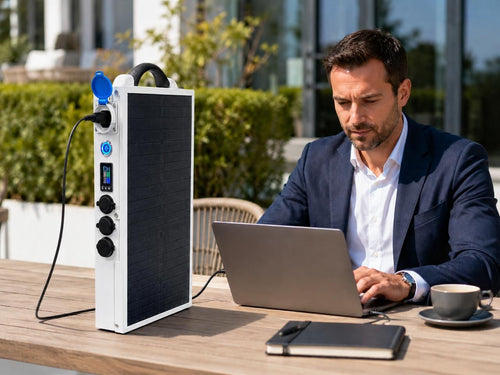
A large power bank with a low-output USB port may store plenty of energy but still be unable to charge a laptop. For laptops, refrigerators, lighting and 230V appliances, a portable power station such as the Mobisun Pro Air 2.0 is often a more suitable solution.
Recommended: Mobisun Pro Air 2.0

Looking for a portable power station that can charge laptops, phones and 230V devices? The Mobisun Pro Air 2.0 offers:
- 500W continuous output (1000W peak) — enough for laptops, monitors and small appliances
- 308Wh LiFePO4 battery — reliable, safe and long-lasting
- IP67 waterproof — suitable for outdoor use
- 6 kg — light enough to carry anywhere
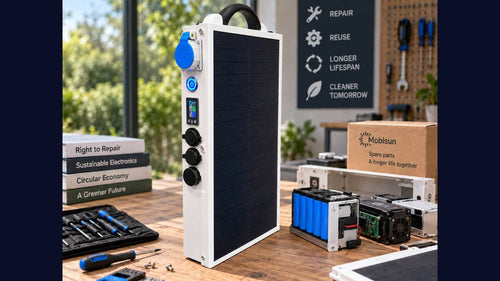
- Fully repairable — individual cells replaceable, 10-year spare parts availability
- USB-C, USB-A, 12V and 230V outputs
What Power-Bank Capacity Do You Need?
The right capacity depends on what you want to charge and how long you need to remain independent from a wall socket.
5,000–10,000 mAh
Suitable for emergency charging, daily use and short trips. These power banks are usually compact enough to carry in a pocket or small bag.
10,000–20,000 mAh
A practical choice for travel, festivals and weekends away. This capacity can normally charge a modern smartphone more than once and may also provide additional power for earbuds or a smartwatch.
20,000–30,000 mAh
Suitable for multiple devices, longer trips and users who regularly charge a tablet. Check the weight and charging time before choosing a larger model.
30,000 mAh and above
Designed for intensive use and longer periods away from the grid. For laptops and professional equipment, also check the Wh capacity and maximum USB-C output.
Portable power stations
For camping, remote work, emergency backup and appliances that require a 230V socket, compare portable power stations in Wh rather than relying only on mAh.
Mobisun portable power stations combine battery storage with USB, 12V and 230V outputs. Selected models can also be recharged using portable solar panels, providing mobile energy where no mains electricity is available. For complete solar charging solutions, Mobisun bundles combine a power station with matching solar panels.
What Else Should You Consider When Buying a Power Bank?
Capacity is important, but it should not be the only factor in your decision. Also consider:
- Output power — determines which devices can be charged and how quickly.
- USB-C Power Delivery — important for fast-charging phones, tablets and laptops.
- Number of ports — useful when charging several devices.
- Weight and dimensions — higher capacity generally means a heavier product.
- Battery chemistry — influences cycle life, weight and safety.
- Pass-through charging — allows devices to be powered while the battery itself is charging.
- Solar compatibility — useful for camping, outdoor work and emergency situations.
- Safety protection — look for protection against overheating, overcharging, short circuits and excessive current.
- Warranty and repairability — especially important for larger power stations.
Choose the right capacity for your needs
mAh tells you how much charge a power bank holds, but real-world output depends on voltage, efficiency and battery quality. Mobisun power banks range from compact everyday chargers to high-capacity models for laptops and outdoor use.
Browse power banksFrequently Asked Questions About mAh
What does 10,000 mAh mean on a power bank?
It means that the internal battery cells have a nominal charge capacity of 10,000 milliampere-hours. The usable capacity delivered to your phone will be lower because energy is lost during voltage conversion and charging.
Is a 10,000 mAh power bank enough?
For most users, 10,000 mAh is a good balance between portability and capacity. It can typically charge a modern smartphone approximately 1.5 to 2 times, depending on the size of the phone battery and charging efficiency.
How long does a 20,000 mAh power bank last?
That depends on the devices being charged. It may provide approximately three full charges for a smartphone with a 5,000 mAh battery, but fewer charges for tablets or laptops.
Does a 20,000 mAh power bank have twice the capacity of a 10,000 mAh model?
When both batteries use the same nominal voltage, a 20,000 mAh model has approximately twice the charge capacity. Actual usable energy can still differ because of efficiency, battery quality and electronics.
Is mAh or Wh more important?
mAh is convenient when comparing similar smartphone power banks. Wh is more useful when comparing batteries with different voltages or when choosing power for laptops, appliances and portable power stations.
Can a high-capacity power bank charge a laptop?
Only when it also supports the voltage and output wattage required by the laptop. Look for USB-C Power Delivery and check the maximum output in watts.
Conclusion: What Does mAh Mean on a Power Bank?
mAh stands for milliampere-hour and indicates the charge capacity of a battery. A higher mAh rating generally means that a power bank can charge your devices more often.
However, mAh is only part of the picture. For an accurate comparison, also consider:
- capacity in Wh;
- real-world charging efficiency;
- maximum output wattage;
- USB-C Power Delivery;
- device compatibility;
- weight and portability.
For smartphones, mAh is a useful starting point. For laptops, outdoor equipment and appliances, Wh and output power are usually more important.
Ready for more than just phone charging?
Need reliable mobile energy for more than a smartphone? Explore the Mobisun Pro Air 2.0 and Mobisun portable power stations for travel, remote work, camping and emergency backup.