
NGO & HUMANITARIAN AID
Solar energy for NGOs and humanitarian aid
Clean energy where it matters most — in disasters, conflicts and crises, electricity is often the first service to fail.
With portable Mobisun power stations and foldable solar panels, aid organisations can quickly set up local energy supply. No fixed grid connection, no continuous fuel supply, and without the noise and exhaust of a traditional generator.
From a compact communications system for a mobile field team to a complete solar power plant for an aid post: Mobisun delivers scalable solutions for humanitarian aid, disaster response, development projects and off-grid locations.
Reliable energy is a prerequisite for effective aid
According to UNHCR, access to safe and sustainable energy is a fundamental human need. Electricity enables lighting, communication, healthcare, cooling and community services. Solar energy can also reduce dependence on diesel generators and vulnerable fuel supply chains.
In healthcare facilities, reliable electricity is essential for lighting, diagnostics, communication, cooling and patient care. WHO and UNICEF therefore increasingly deploy solar energy systems with battery storage at health centres and medical warehouses.
Mobisun focuses on portable and rapidly deployable energy solutions within this landscape. The systems can be used standalone or as part of a larger energy system with multiple power stations, solar panels and central charging points.
What can NGOs use Mobisun for?
Six common applications in humanitarian missions, disaster response and field operations.
Communication during emergency relief and disaster response
Reliable communication is essential to coordinate teams, register aid requests and maintain contact with local partners, authorities and international coordination centres.
- Smartphones and satellite phones
- Walkie-talkies and battery chargers
- Laptops and tablets
- 4G and 5G routers
- Starlink Mini
- Radio equipment and mobile hotspots
- Cameras and documentation equipment
Lighting at aid posts and temporary shelters
Proper lighting increases the usability of temporary facilities after sunset and helps people work, study and move around safely in the evening.
- Registration and information points
- First aid posts
- Sanitary facilities
- Storage spaces
- Temporary classrooms
- Community spaces
- Security posts
- Tents and mobile workspaces
Mobile healthcare and field clinics
In a mobile clinic, power is needed for more than just medical equipment. Lighting, registration, communication, temperature measurement and charging tools also depend on electricity.
- Treatment and examination lighting
- Laptops and patient registration
- Communication and routers
- Small monitors and measuring equipment
- Approved cooling equipment
- Administration and reporting
Education and digital information services
After a disaster or in long-term shelter situations, access to education and information can quickly come under pressure. A portable energy system makes it possible to set up temporary learning and information points.
- Laptops and tablets
- Small displays and projectors
- Routers and internet equipment
- LED lighting and speakers
- Digital teaching materials
- Charging devices for teachers and students
Registration, distribution and logistics
At a distribution point or logistics hub, electricity is needed to coordinate goods flows and aid delivery.
- Barcode and QR scanners
- Laptops, tablets and label printers
- Inventory registration
- Storage space lighting
- Temperature and humidity sensors
- Cameras and security equipment
Water, sanitation and monitoring
Water and sanitation projects are often located in places without reliable grid access. Mobisun systems can be used for energy-efficient supporting equipment.
- Sensors and data loggers
- Water quality meters
- Communication equipment
- Small dosing or sampling equipment
- Lighting and laptops
- Mobile monitoring stations
Why portable solar energy for humanitarian aid?
Rapidly deployable
A mobile power station does not need to be permanently installed first. The system can be charged, transported and deployed on-site immediately — valuable during the first phase of a crisis.
No continuous fuel supply
Diesel generators depend on fuel transport, storage and distribution. Exactly in emergencies these logistics chains can be disrupted. Decentralised solar energy systems reduce this dependency.
Silent in operation
Power stations have no combustion engine. This allows them to be used at medical posts, sleeping locations, registration points and during night-time relief operations.
No local exhaust fumes
During operation, a battery power station produces no local combustion gases. This enables use in locations where a fuel generator is less suitable due to noise, smell or ventilation.
Modular and scalable
An organisation can start with one unit per field team and later expand to multiple systems per location, a central charging point, or a larger 3000Wh energy hub.
Broadly applicable
The same equipment can be used across different mission phases. First as energy supply for a response team, later for a clinic, school, logistics point or local partner organisation.
Mobisun products for NGOs and humanitarian deployment
From compact field kits to central energy hubs — six solutions for every mission scale.
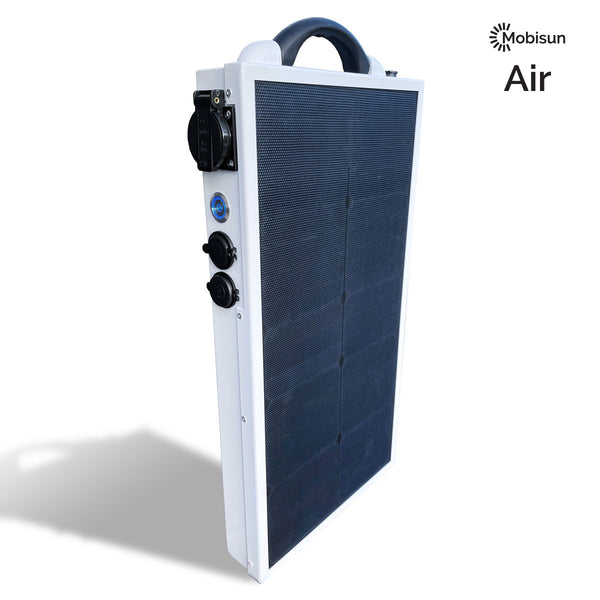
Mobisun Pro Air (standalone power station)
Cabin luggage for immediate deployment in emergency operations
154Wh LiFePO₄ · 300W continuous · 600W peak · 2.1 kgThe standalone Mobisun Pro Air weighs just 2.1 kg and falls within cabin luggage limits. With airline approval, the device may be carried as hand luggage in the cabin of a passenger aircraft — ideal for emergency operations where power is needed on-site within hours of a disaster or crisis.
Immediately deployable for basic services: charging phones and satellite phones, LED lighting, small medical devices or a laptop. Always check the rules of the airline and the destination country in advance, as these may vary per flight.
Suitable for
- Phone and satellite phone charging
- LED lighting
- One laptop or tablet
- Small medical devices
- Display and camera
- First reception and assessment
- Rapid emergency kit
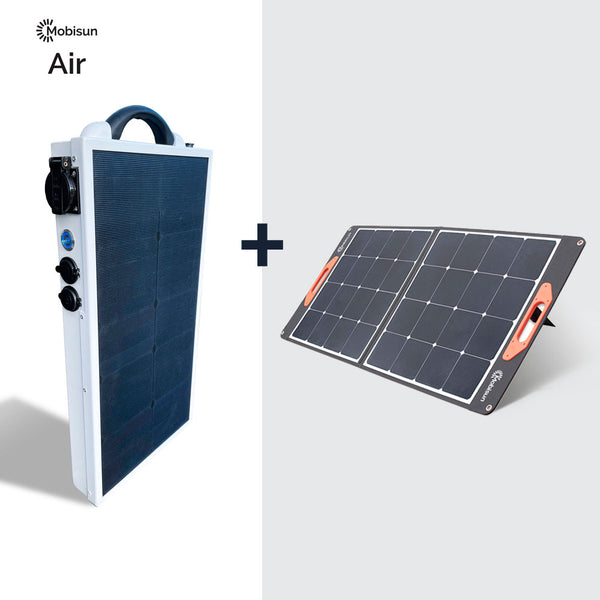
Mobisun Pro Air with 60W solar panel
Compact energy for mobile field teams
154Wh LiFePO₄ · 300W continuous · 600W peak · 6.9 kgThe Mobisun Pro Air is suitable for teams that need to travel fast and light. The system features 230V, 12V and USB connections and can be combined with a foldable 60W solar panel.
Under favourable conditions, the bundle can be charged in about three effective solar hours. Pass-through charging allows devices to be used while the battery is being recharged.
Suitable for
- Phones and tablets
- One laptop
- Walkie-talkies
- LED lighting
- Small measuring equipment
- Cameras
- Mobile registration teams
Mobisun Pro Classic with 100W solar panel
More capacity for coordination and field work
259Wh NMC · 300W continuous · 500W peak · 9.6 kgThe Pro Classic offers more battery capacity for teams that want to use multiple devices or bridge a longer period without grid power.
The bundle combines an integrated 29W panel with a foldable 100W solar panel. The specified charging time under favourable conditions is approximately 3.5 effective solar hours.
Suitable for
- Multiple phones and tablets
- Laptops and routers
- Lighting for a small aid post
- Camera and drone batteries
- Field administration
- Communication sets
- Charging tool batteries
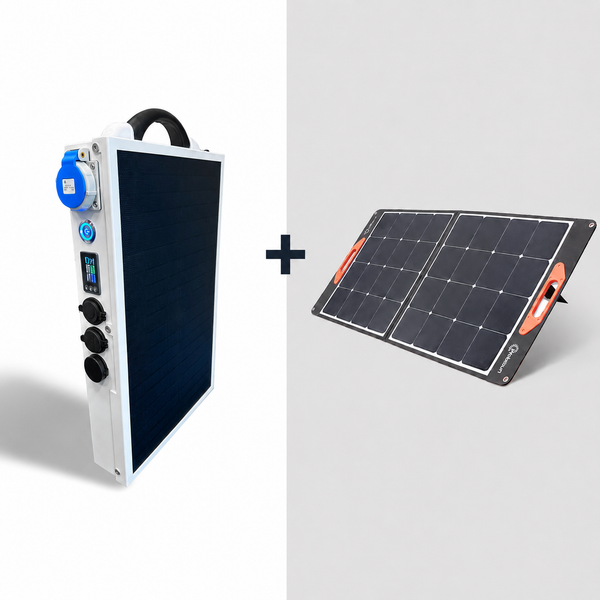
Mobisun Pro Air 2.0 with 100W solar panel
Rugged and repairable energy for demanding missions
308Wh LiFePO₄ · 500W continuous · 1000W peak · IP67The Mobisun Pro Air 2.0 is designed for intensive use and conditions where dust, rain and transport stress play an important role.
The system features an IP67-rated aluminium housing, two 100W USB-C PD ports, a 230V socket, USB-A and a 12V output. The LiFePO₄ battery is designed for more than 3,000 charge cycles.
All key components are modular and replaceable. This can extend the lifespan and makes maintenance more practical in locations where returning or fully replacing equipment is difficult.
Suitable for
- Disaster response
- Mobile command posts
- Field clinics
- Communication hubs
- Starlink Mini
- Technical field work
- Inspection and assessment teams
- Missions with rain, dust and intensive transport
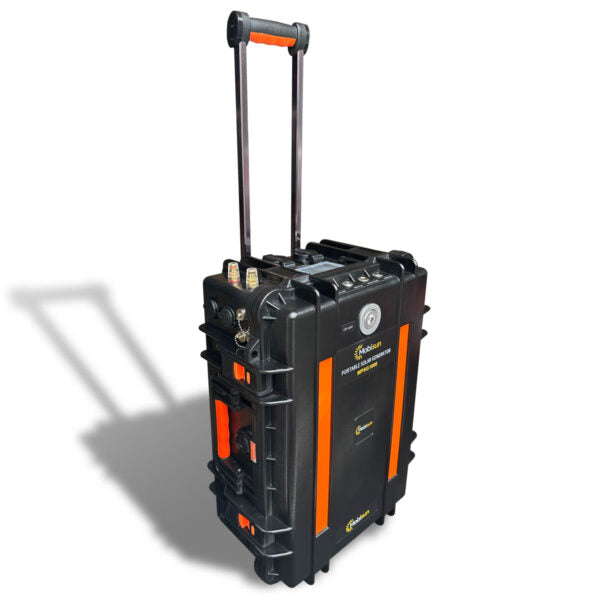
Mobisun Portable Solar Generator 3000Wh
Central energy supply for a field office or aid post
3000Wh · 1800W continuous · 3600W peak · 25 kg · wheeledThe Portable Solar Generator is intended for locations where multiple devices need to operate simultaneously or where energy is needed for extended periods.
The system delivers 230V pure sine wave output, has a 3000Wh battery capacity and can be charged via grid or solar panels. Thanks to the wheels, the energy hub can be moved within a camp, warehouse or field location.
Suitable for
- Temporary field office
- Central communication post
- Larger registration facility
- Multiple laptops and routers
- Aid post lighting
- Medical equipment within specifications
- Approved cooling equipment
- Central charging facility

Mobisun PSG1800 bundle with 4 × 300W solar panels
Longer off-grid operation with up to 1200W of solar power
3000Wh · 1800W continuous · 4 × 300W solar panelsThe PSG1800 bundle combines the 3000Wh generator with four foldable 300W solar panels. This creates a complete mobile energy hub with up to 1200W of installed solar power.
The bundle is particularly suitable for larger locations that need to generate a lot of energy during the day and want to store it for use during the evening, night or periods with less sun.
Suitable for
- Field offices
- Logistics hubs
- Medical aid posts
- Temporary educational facilities
- Communication centres
- Remote project locations
- Long-term emergency relief
- Local NGO offices without reliable grid
Compare Mobisun solutions
The right solution is not only determined by maximum power. Desired autonomy, local solar yield, transport options, starting peaks and required reserve also play an important role.
| System | Battery capacity | Continuous power | Solar panel | Recommended use |
|---|---|---|---|---|
| Pro Air (standalone) | 154Wh | 300W | Optional | Cabin luggage — emergency ops and first response |
| Pro Air bundle | 154Wh | 300W | 60W + integrated | Mobile teams, communication and lighting |
| Pro Classic bundle | 259Wh | 300W | 100W + integrated | Field work, registration and small aid posts |
| Pro Air 2.0 bundle | 308Wh | 500W | 100W + integrated | Professional relief and demanding conditions |
| Portable Solar Generator | 3000Wh | 1800W | Optional | Field office, central aid post and multiple devices |
| PSG1800 bundle | 3000Wh | 1800W | 4 × 300W | Long-term off-grid use and central facilities |
Example deployment kits
Five configurations for common mission profiles — as a starting point for a tailored project proposal.
Mobile communication team
- 1 × Mobisun Pro Air
- 1 × foldable 60W solar panel
- USB-C and charging cables
- LED lamp
- Adapters for radio and communication equipment
- Protective transport bag
Registration and assessment team
- 1 × Pro Classic with 100W solar panel
- 2 laptops or tablets
- Mobile router
- Phone chargers
- Small printer or scanner (after consumption check)
- LED lighting
Rugged rapid-response kit
- 1 × Pro Air 2.0
- 1 × 100W solar panel
- Communication set
- Two USB-C cables
- 12V lighting
- Spare cables and fuses
- Basic set of replacement parts
Small field clinic or health post
- 1 or more Pro Air 2.0 systems for mobile equipment
- Portable Solar Generator 3000Wh for central equipment
- Solar panels matching daily consumption
- Separate emergency reserve
- Energy-efficient LED lighting
- Battery and consumption monitoring
Central field office or logistics point
- 1 × PSG1800 bundle
- 2 or more Pro Air or Pro Air 2.0 units for mobile teams
- Central charging table
- Cable and adapter set
- Spare parts
- Local user training
Vaccination programme or mobile cold chain
- 1 × Pro Air 2.0 for medication registration and lighting
- Portable Solar Generator 3000Wh for approved vaccine refrigerator
- Solar panels for autonomous daytime operation
- Temperature monitoring and data logging
- Alarm and backup provision for critical hours
- Reserve Pro Air for backup
How to size a humanitarian energy system
Five steps to arrive at the right system choice.
1. Inventory all equipment
Note for each device the average power in watts, maximum or starting power, hours of use per day, connection (USB, USB-C, 12V or 230V), necessity and priority, and daytime or night-time use.
2. Calculate daily energy consumption
Use the formula: power in watts × hours of use = energy consumption in Wh. Also account for conversion losses, cloudy days and additional consumption.
3. Check peak power
Refrigerators, pumps, compressors, printers and some medical devices can temporarily demand much more power during startup than during normal operation. The peak power must remain within the specifications of the chosen inverter.
4. Determine desired autonomy
Should the system bridge one night, one day or multiple days without solar yield? For critical equipment a larger energy reserve is needed than for non-essential applications.
5. Calculate required solar yield
The yield of solar panels depends on location and season, cloud cover, temperature, shade, orientation, tilt angle, dust and pollution, and effective sun hours. A system must therefore not be sized only on the nominal power of the panel.
Sustainability also means maintenance and lifespan
A humanitarian energy project is only sustainable when the system continues to function after the initial delivery. Important parts of a project plan are:
- Training of local users
- Clear manuals
- Availability of spare cables
- Replaceable connectors and fuses
- Local responsibility for maintenance
- Periodic battery inspection
- Solar panel cleaning
- Consumption and yield monitoring
- Safe storage and transport
UNICEF emphasises in solar energy projects not only installation, but also long-term maintenance, local skills and proper sizing. The modular and repairable construction of the Pro Air 2.0 fits well with missions where equipment must last long.
Procurement and rollout for NGOs
Mobisun can support organisations with:
- Selection of the right model
- Energy consumption calculation
- Pilots and practical tests
- Delivery of multiple systems
- Configuration of complete field kits
- Cables and adapters
- Spare parts
- Multilingual documentation
- International delivery
- Business and project quotes
Mobisun delivers solutions from compact 154Wh power stations to business energy systems of 3000Wh and larger. For project deliveries, larger volumes and custom solutions, volume and enterprise options are available.
Frequently asked questions about solar energy for humanitarian aid
Which Mobisun system is suitable for a mobile field team?
For phones, one laptop, walkie-talkies and lighting, the Pro Air with 60W solar panel is usually the most portable solution. For more devices or longer use, the Pro Classic is more suitable. For intensive use in dust and rain, the Pro Air 2.0 offers additional benefits thanks to its IP67 housing and repairable construction.
Can Mobisun power stations power medical equipment?
This is possible when the normal power, peak power, voltage and required power quality fall within specifications. Check each device separately with the manufacturer or technical specialist. For life-support equipment a certified and redundant emergency power system is required.
Can a Mobisun be used for vaccine cold chain?
A Mobisun can support certain cooling equipment when consumption, starting power and required autonomy are correctly calculated. However, a vaccine cold chain process requires validated cold-chain equipment, temperature monitoring, alarms and a backup provision. The power station alone does not constitute a complete certified cold chain.
Do the solar panels also work in cloudy conditions?
Yes, but the yield is lower than in direct sunlight. For critical applications the system must be sized for worse weather conditions and sufficient battery reserve or an additional power source must be available.
Can devices be used while charging?
Yes. The Mobisun Pro Air, Pro Classic and Pro Air 2.0 support pass-through charging. This allows the system to receive solar energy while connected devices are being used.
Are Mobisun systems suitable for outdoor use?
The Pro Air and Pro Classic are IP54-rated and protected against dust and splashing water. The Pro Air 2.0 is IP67-rated. Adapters, plug connections and connected equipment must always be appropriately protected against moisture.
Can the systems be transported by air?
Lithium batteries are subject to international transport regulations. The allowed transport method depends on battery capacity, airline, route and whether it concerns passenger or cargo transport. Always check this in advance with the carrier and shipping partner.
Can Mobisun deliver larger quantities?
Yes. For NGOs, governments, distributors and humanitarian organisations, project pricing, pilots, volume quotes and appropriate configurations can be discussed. The final schedule depends on quantities, destination, documentation and desired accessories.
Clean energy that moves with the mission
Humanitarian energy must be reliable, simple and flexible. A system must be quickly deployable, but also remain usable when the initial emergency phase is over.
Mobisun offers portable solar energy for every scale: compact energy for mobile teams, rugged power stations for professional relief, solar energy for field clinics and registration points, central power for field offices and modular systems for long-term off-grid projects.