
Power banks are extremely useful when travelling. They keep your smartphone, tablet, headphones and other devices charged while you are away from a wall socket.
However, power banks contain lithium batteries. Because damaged or overheated lithium batteries can catch fire, airlines apply strict rules to how they may be transported.
So, can you take a power bank on a plane? In most cases, yes — but only in your carry-on baggage, provided the battery is within the permitted watt-hour limit. Portable power stations are more complicated because their batteries are usually much larger. If you want to dive deeper into battery capacity first, read our guide on what mAh means on a power bank.
This guide explains the international, European and United States rules for flying with power banks and portable power stations in 2026.
Quick answer — 2026 rules at a glance
- Power banks must be carried in hand luggage only, never in checked baggage.
- Capacity limit: up to 100 Wh generally permitted.
- IATA 2026: maximum 2 power banks, each ≤ 100 Wh per passenger.
- Above 100 Wh: increasingly refused (IATA 2026 lists them as forbidden).
- Above 160 Wh: prohibited in passenger baggage.
- Most portable power stations exceed 160 Wh and cannot travel as passenger baggage.
Can You Carry a Power Bank in Hand Luggage?
Yes. A normal power bank can usually be carried in hand luggage when its capacity does not exceed 100 Wh.
Power banks are treated as spare lithium batteries because they are designed primarily to provide energy to another device. Spare lithium batteries must remain in the aircraft cabin, where passengers and cabin crew can notice and respond to overheating, smoke or damage.
They may not be placed in checked baggage. This rule also applies when your cabin bag is taken from you at the gate. Remove the power bank before the bag is placed in the aircraft hold.
Can a Power Bank Go in Checked Baggage?
Warning — never in checked baggage
Power banks with lithium-ion batteries must not be packed in checked luggage — even when switched off, empty, in a protective case, locked suitcase, or on a short flight. TSA, FAA, EASA and IATA all require them in the aircraft cabin.
What Is the Maximum Power-Bank Capacity Allowed on a Plane?
Airline battery limits are expressed in watt-hours, abbreviated as Wh.
| Battery capacity | International position in 2026 | Airline approval |
|---|---|---|
| Up to 100 Wh | Generally allowed in carry-on baggage | Normally not required |
| 100–160 Wh | IATA 2026 power-bank guidance lists these as forbidden | FAA may permit up to two with airline approval |
| Above 160 Wh | Not permitted in normal passenger baggage | Cannot normally be approved |
The important change for 2026 is that IATA's latest passenger guidance specifically limits power banks to two units of no more than 100 Wh each. Its accompanying table lists power banks above 100 Wh as forbidden.
US FAA rules remain somewhat different: a power bank between 101 and 160 Wh may be permitted with advance airline approval, with a limit of two larger spare batteries per passenger.
For an international itinerary, follow the strictest rule applying to your airline, departure airport, transfer airports and destination. Do not assume that a 100–160 Wh power bank will be accepted merely because one national authority allows airline approval.
How Many Power Banks Can You Take on a Plane in 2026?
IATA's 2026 passenger guidance states that passengers are limited to a maximum of:
IATA 2026 limit
Two lithium-ion power banks, each not exceeding 100 Wh.
The guidance also notes that some of these tighter measures are being adopted by airlines before they have been incorporated into every national regulation. Airlines may therefore apply different or stricter conditions.
In the United States, the FAA does not impose a general numerical limit on batteries below 100 Wh when they are for the passenger's personal use. However, it warns that individual airlines may set stricter quantity limits.
For international travel, carrying no more than two power banks below 100 Wh is the safest approach.
How Do You Convert mAh to Wh?
Many power banks display their capacity in milliampere-hours, or mAh, rather than watt-hours. Learn more in our detailed guide on what mAh means on a power bank.
Formula — mAh to Wh
Wh = mAh × voltage ÷ 1,000
For example, a 20,000 mAh power bank with a nominal voltage of 3.7 volts contains:
20,000 × 3.7 ÷ 1,000 = 74 Wh
That means a typical 20,000 mAh power bank is below the 100 Wh limit.
Always use the voltage printed on the power bank itself. Do not use the 5V, 9V or 12V USB output voltage for this calculation. The relevant figure is the nominal voltage of the internal battery cells. The FAA uses the same voltage-times-amp-hours calculation when determining a battery's Wh rating.
Common Power-Bank Capacities
The examples below assume a nominal internal battery voltage of 3.7V.
| Advertised capacity | Approximate energy | Usual 2026 status |
|---|---|---|
| 5,000 mAh | 18.5 Wh | Generally permitted |
| 10,000 mAh | 37 Wh | Generally permitted |
| 20,000 mAh | 74 Wh | Generally permitted |
| 26,800 mAh | 99.2 Wh | Just below 100 Wh |
| 30,000 mAh | 111 Wh | May be refused; above IATA's power-bank limit |
| 40,000 mAh | 148 Wh | Not accepted under IATA's 2026 power-bank guidance |
| 50,000 mAh | 185 Wh | Prohibited in passenger baggage |
These are estimates. The rating printed on the product label is the figure used by the airline or airport security personnel. A power bank advertised as 26,800 mAh is often designed to remain just below 100 Wh — but confirm the Wh value on its label before travelling.
Can You Take a 20,000 mAh Power Bank on a Plane?
Usually, yes. At a nominal voltage of 3.7V, a 20,000 mAh power bank contains approximately 74 Wh. That places it below the common 100 Wh limit.
It must still:
- be packed in your carry-on baggage;
- have its capacity clearly marked;
- be protected against accidental activation and short circuits;
- be in good condition;
- comply with your airline's quantity restrictions.
Can You Take a 30,000 mAh Power Bank on a Plane?
A typical 30,000 mAh power bank at 3.7V has a capacity of approximately 111 Wh.
Under IATA's 2026 guidance for power banks, this exceeds the 100 Wh limit and should therefore be considered unsuitable for international passenger travel.
Under US FAA rules, a 101–160 Wh power bank may potentially be carried with advance airline approval. Approval is not automatic, and other countries, transfer airports or airlines may apply stricter rules.
Can You Take a Portable Power Station on a Plane?
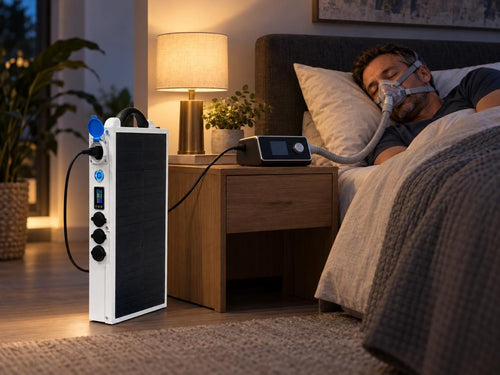
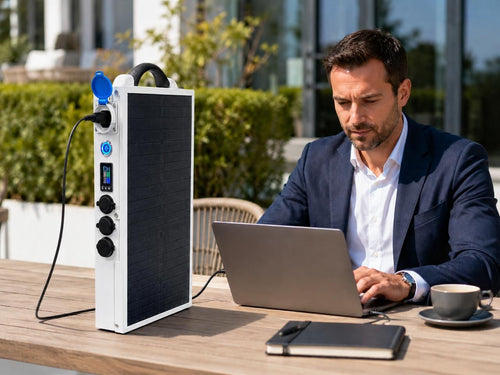
Most portable power stations cannot be carried on a passenger aircraft because their battery capacities exceed 160 Wh.
Portable power stations commonly contain batteries of 150 Wh, 250 Wh, 300 Wh, 500 Wh, 1,000 Wh, 2,000 Wh or more.
- A power station below 100 Wh may potentially be accepted as cabin baggage, subject to airline rules.
- A model between 100 and 160 Wh is more complicated. Depending on its design, the airline may classify it as a portable electronic device, a power bank or a lithium-battery-powered generator. Advance written approval is essential, and acceptance is not guaranteed.
- Power stations above 160 Wh cannot normally travel as checked or carry-on baggage. The FAA specifically lists stand-alone battery generators and solar-system backup generators exceeding 160 Wh as forbidden on passenger aircraft. They must instead be transported through an approved dangerous-goods cargo service.
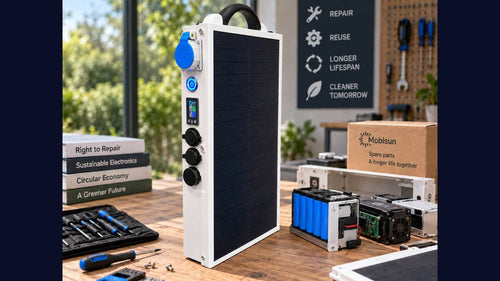
Can You Take a Mobisun Power Station on a Plane?
The battery capacity determines whether a Mobisun model may be considered for air travel.
| Mobisun model | Battery capacity | Passenger-aircraft guidance |
|---|---|---|
| Mobisun Pro Air | 154 Wh | Do not assume it is permitted; written airline approval and classification are required |
| Mobisun Pro Classic | 259 Wh | Above 160 Wh; not permitted in passenger baggage |
| Mobisun Pro Air 2.0 | 308 Wh | Above 160 Wh; not permitted in passenger baggage |
| Mobisun Pro Max 2.0 | 610 Wh | Above 160 Wh; not permitted in passenger baggage |
Important — 154 Wh is NOT automatically IATA-compliant
The Mobisun Pro Air has a capacity of 154 Wh. Under the general US battery framework, a battery of this size might be considered with airline approval. However, IATA's 2026 passenger guidance specifically prohibits power banks above 100 Wh. Whether the Pro Air is accepted as a portable electronic device or refused as a power bank or generator is ultimately determined by the airline.
Never arrive at the airport assuming that a 154 Wh power station will be accepted. Obtain written confirmation from every operating airline before travelling.
The Mobisun Pro Classic, Pro Air 2.0 and Pro Max 2.0 exceed 160 Wh and therefore cannot normally be carried as passenger baggage. Their published capacities are 259 Wh, 308 Wh and 610 Wh respectively.
Does LiFePO₄ Make a Power Station Airplane-Safe?
Not automatically. LiFePO₄, or lithium iron phosphate, is a type of rechargeable lithium-ion battery chemistry. Although it is valued for its stability and long cycle life, airline transport limits are still primarily determined by:
- the battery's Wh rating;
- whether it is installed or spare;
- the type of device;
- the airline's own policy;
- applicable national and international rules.
A 300 Wh LiFePO₄ power station is therefore not allowed simply because it uses LiFePO₄ cells.
Can You Use a Power Bank During the Flight?
Do not assume that you may use or charge a power bank onboard. IATA's 2026 guidance says:
- a power bank must not be recharged from an aircraft power supply;
- it should not be used to power devices during taxi, take-off or landing;
- it should not be stored in the overhead locker.
EASA goes further by advising that power banks should not be connected to or provide power to another device while onboard the aircraft.
Some airlines prohibit power-bank use throughout the entire flight. Others require it to remain visible and accessible rather than inside a bag or overhead compartment. Always follow cabin-crew instructions.
How Should You Pack a Power Bank?
Use this checklist before leaving for the airport:
1. Place it in your hand luggage
Never put the power bank in checked baggage.
2. Check the Wh rating
Look for a clear Wh marking on the power bank. When only mAh and voltage are shown, calculate the Wh value before travelling.
3. Protect it against short circuits
Keep the power bank in its original packaging, a separate protective pouch or a plastic bag. Protect exposed contacts or terminals where necessary.
4. Prevent accidental activation
Make sure buttons cannot be pressed accidentally. Switch off wireless or magnetic charging functions.
5. Keep it accessible
Do not bury it at the bottom of your bag. IATA's 2026 guidance recommends that power banks should not be stored in overhead lockers.
6. Do not travel with a damaged battery
Do not carry a power bank that is swollen, cracked, leaking, unusually hot, recalled or otherwise damaged. Damaged and recalled lithium batteries can be prohibited from both carry-on and checked baggage.
What If Your Hand Luggage Is Checked at the Gate?
Small aircraft and full flights sometimes require passengers to place cabin baggage in the hold at the gate. Before handing over the bag:
- Remove every power bank.
- Remove spare camera, drone and laptop batteries.
- Keep these batteries with you in the cabin.
- Remove other lithium-powered devices when instructed by the airline.
A power bank does not become suitable for checked baggage simply because an airline employee takes your cabin bag at the gate.
Are the Rules the Same in Europe and the United States?
The basic principles are similar, but there are important differences.
European and international travel
EASA requires spare batteries and power banks to be carried in hand luggage and individually protected against short circuits. It also advises passengers not to recharge power banks or use them to provide power onboard. IATA's 2026 passenger guidance sets a limit of two power banks, each no greater than 100 Wh.
United States
The TSA requires power banks to be placed in carry-on baggage. The FAA permits rechargeable batteries up to 100 Wh. Batteries from 101 to 160 Wh may be allowed with airline approval, with a maximum of two larger spare batteries per passenger. Batteries above 160 Wh are forbidden on passenger aircraft.
International journeys
Your journey may involve several sets of rules. For example, a US airline could approve a 111 Wh battery, while a connecting airline or international airport may refuse it. Check the operating airline (not only the ticket seller), every connecting airline, the departure and destination country, the device classification, and whether written approval is required.
Can You Take a Solar Panel on a Plane?
A portable solar panel without an integrated lithium battery is not itself a power bank. The lithium-battery restrictions discussed in this article therefore do not apply to a battery-free solar panel. Normal airline rules for cabin-baggage dimensions, checked-baggage size, weight and fragile items still apply.
When a solar panel contains an integrated battery, the battery capacity determines how it must be transported. A solar panel connected to a power station does not make the battery exempt from the Wh limits.
Travel with the right power bank
Make sure your power bank is clearly labelled with its Wh rating, pack it in your hand luggage, and choose a model that meets airline rules. Mobisun power banks are designed for travel, outdoor use and everyday backup.
Browse power banksFrequently Asked Questions
Can I take two 20,000 mAh power banks on a plane?
Usually, yes. At 3.7V, each contains approximately 74 Wh. IATA's 2026 guidance allows a maximum of two power banks not exceeding 100 Wh each. Your airline can still impose a stricter limit.
Can I put a power bank in my suitcase?
Only when "suitcase" means cabin baggage. A power bank may not be placed in a suitcase that travels in the aircraft hold.
Must the power bank be empty before flying?
The general passenger limit is based on Wh rather than the displayed charge percentage. IATA advises passengers to avoid last-minute charging and notes that airlines may prefer batteries at a low state of charge. Check your airline for any specific percentage requirement.
What happens when the Wh rating is missing?
Airline or security staff may be unable to verify that the battery is within the permitted limit. Use a power bank with a permanent, clearly legible capacity label and bring the manufacturer's specifications when there is any uncertainty.
Are magnetic or wireless power banks allowed?
They are subject to the same Wh and baggage rules. Switch wireless charging off and store the power bank far enough from the phone to prevent accidental charging.
Can I take a laptop power bank on a plane?
Yes, when it is no more than 100 Wh and meets the airline's conditions. High-output USB-C wattage does not determine whether it is permitted — the battery's Wh capacity does.
Can a portable power station be sent separately?
Power stations that exceed passenger limits may sometimes be shipped as regulated dangerous goods. This requires approved packaging, documentation, labelling and a carrier that accepts lithium batteries. Contact a qualified dangerous-goods freight provider rather than sending it as a normal parcel.
Conclusion
You can usually take a power bank on a plane when:
- it does not exceed 100 Wh;
- it is packed in your carry-on baggage;
- it is in good condition;
- its capacity is clearly marked;
- it is protected from short circuits;
- you comply with the airline's quantity and usage rules.
For 2026, the safest international approach is to carry no more than two power banks below 100 Wh. Do not assume that a power bank between 100 and 160 Wh will be accepted. IATA's updated guidance prohibits power banks in that range, although US rules may still allow them with advance airline approval.
Most portable power stations exceed 160 Wh and cannot travel as passenger baggage. They are better suited to journeys by car, campervan, train, boat or ferry — or must be transported separately through an approved dangerous-goods carrier.
Travelling by road, rail or campervan?
Explore Mobisun portable power stations and portable solar panels for reliable off-grid energy wherever your journey takes you. Want a complete setup in one click? Browse our bundle deals, or consider the Mobisun Pro Air 2.0 (308 Wh, IP67, fully repairable) for campervans, home backup and remote work.