
Temporary electricity is essential on almost every construction site. Power may be required for tools, site cabins, lighting, security cameras, Wi-Fi, pumps, charging stations and access-control systems — often before a permanent grid connection is available.
For decades, the standard answer was simple: install a diesel generator and keep it running.
Today, construction companies have another option. A solar generator combines solar panels, battery storage and an inverter to provide electricity without continuously burning fuel. Larger systems may also include a backup generator, creating a hybrid power supply that uses solar and battery energy first and diesel only when necessary.
But which solution is better for your project? The answer depends on more than the initial purchase or rental price. A meaningful comparison must include fuel consumption, transport and refuelling, maintenance, noise, local emissions, night-time operation, operating hours, power peaks, project duration, battery and solar capacity, residual value and total cost of ownership.
This guide compares solar generators and diesel generators for professional construction sites and explains when to choose a Portable Power Station, a mobile Solar Trailer or a larger containerised energy system.
Solar Generator vs Diesel Generator: Quick Comparison
| Factor | Solar generator or battery system | Diesel generator |
|---|---|---|
| Initial cost | Usually higher | Often lower |
| Ongoing energy cost | Low when charged by solar | Continuous fuel expense |
| Maintenance | Limited routine maintenance | Engine servicing, filters, oil and fuel system |
| Noise | Very low during battery operation | Continuous engine noise while running |
| Local exhaust | None during battery operation | CO₂, NOx, particulates and other exhaust |
| Night-time use | Quiet stored energy | Engine may need to run through the night |
| Refuelling | Solar or mains charging | Regular diesel deliveries |
| Low continuous loads | Highly suitable | Generator may run for a relatively small load |
| Heavy tools and high peaks | Requires correctly sized inverter | Well suited when correctly sized |
| Cloudy periods | Battery reserve or backup required | Continues while fuel is available |
| Remote monitoring | Available on selected systems | Depends on generator and control system |
| Indoor use | Battery systems may be used where product and fire-safety rules allow | Combustion generators must not be used indoors |
| Best overall solution | Often solar-battery or hybrid | Useful for temporary, unpredictable or very high loads |
Rule of thumb
A diesel generator can still be appropriate for short projects with large and unpredictable loads. For sites with recurring demand, security equipment, lighting or long operating hours, a solar-battery or hybrid system can substantially reduce engine runtime.
What Is a Solar Generator?
A solar generator is not a combustion engine. It is an electrical energy system consisting of:
- solar panels;
- a battery;
- a charge controller;
- an inverter;
- AC and DC connections;
- monitoring and safety equipment.
The solar panels generate energy during daylight. The battery stores that energy so it can be used later, including at night or during cloudy periods.
A small solar generator may be a Portable Power Station that can be moved by one person. Larger construction-site systems can be built into a road-legal trailer or a 20ft Solar Container or 40ft Solar Container.
Some professional solar systems also include a backup diesel generator. In that configuration, the battery and solar panels supply most normal loads, while the generator remains available for prolonged poor weather, unusually high consumption or additional security of supply.
What Is a Diesel Generator?
A diesel generator combines a diesel engine with an electrical generator. As long as fuel is available, it can provide continuous electricity within its rated output.
Diesel generators are widely used because they:
- are familiar to site managers;
- can supply high electrical loads;
- are available in many sizes;
- are easy to rent;
- can run day and night;
- do not depend directly on sunlight.
The disadvantage is that the engine must keep running whenever electricity is required. This creates fuel consumption, servicing requirements, noise and exhaust emissions — even when the connected load consists only of a few cameras and LED lights.
Purchase Versus Rental
The first financial decision is not necessarily solar versus diesel. It is whether the equipment should be purchased or rented.
When renting may make sense
Rental is often attractive when:
- the project is short;
- the energy demand is uncertain;
- the required capacity may change;
- no capital budget is available;
- the equipment is needed at only one location;
- maintenance and service need to be outsourced;
- the site requires an immediate temporary solution.
A rental agreement can provide predictable monthly costs and reduce responsibility for servicing. However, fuel, transport, call-outs and additional operating hours may still be charged separately.
When purchasing may make sense
Purchasing becomes more attractive when:
- systems are repeatedly deployed across projects;
- the equipment will be used for several years;
- the site has predictable daily consumption;
- the company wants to reduce fuel exposure;
- the organisation has sustainability or tender requirements;
- the asset can be redeployed or rented internally;
- residual value is important;
- remote energy is part of the company's long-term operations.
Real comparison
The correct comparison is therefore not simply purchase price solar versus purchase price diesel. It is total lifetime cost of solar versus the total lifetime cost of diesel.
Compare Total Cost of Ownership
A diesel generator may appear less expensive when only the initial price is considered. The operating cost continues for every hour the engine runs. A complete comparison should include the following.
Diesel-generator costs
- purchase or rental;
- diesel fuel;
- fuel delivery;
- generator transport;
- oil and filters;
- periodic servicing;
- breakdowns and call-outs;
- refuelling labour;
- theft prevention;
- fuel storage;
- environmental measures;
- noise-control equipment;
- generator replacement or depreciation.
Solar-generator costs
- purchase or rental;
- solar panels;
- battery storage;
- inverter;
- transport and installation;
- inspections;
- occasional cleaning;
- battery degradation;
- financing;
- insurance;
- backup-generator fuel, where applicable.
Why this matters
Solar-battery systems normally shift expenditure from recurring fuel and maintenance towards the initial installation. This is why project duration and annual operating hours strongly affect the business case.
How to Calculate Diesel Fuel Costs
Use this formula:
Fuel-cost formula
Annual fuel cost = fuel consumption per hour × operating hours × diesel price
Illustrative construction-site example
Assume:
- diesel consumption: 2 litres per hour;
- operating time: 10 hours per day;
- operating days: 250 per year;
- diesel price: €1.80 per litre.
The annual consumption would be: 2 × 10 × 250 = 5,000 litres
The annual fuel cost would be: 5,000 × €1.80 = €9,000
Excluded costs
This example does not include fuel delivery, refuelling labour, servicing, rental, breakdowns, theft or administration. The actual business case must use the generator's measured fuel consumption and the delivered fuel price at the project location.
Do not use maximum generator output as the load
A 20 kVA generator does not necessarily supply 20 kVA continuously. Many sites use large generators to accommodate occasional peaks while the normal overnight load may be only a small fraction of the installed capacity.
Measure or estimate:
- average daytime consumption;
- maximum simultaneous consumption;
- startup peaks;
- overnight base load;
- weekend consumption;
- seasonal demand.
These load profiles determine whether a battery, hybrid system or conventional generator is most economical.
Diesel Use and CO₂ Emissions
Burning one litre of mineral diesel produces roughly 2.6 to 2.7 kilograms of CO₂ at the point of combustion. This does not include all upstream emissions from extraction, refining and transport.
CO₂ formula
Combustion CO₂ in kilograms = litres of diesel × approximately 2.65
Using the example of 5,000 litres per year: 5,000 × 2.65 = approximately 13,250 kg CO₂
That equals approximately 13.25 tonnes of direct CO₂ emissions per year.
70% diesel-reduction scenario
If a solar-battery system reduced diesel consumption by 70% in this illustrative scenario, it would avoid approximately:
- 3,500 litres of diesel;
- €6,300 in fuel at €1.80 per litre;
- 9.3 tonnes of direct combustion CO₂.
Actual savings depend on the load profile, system design, location, weather and backup-generator strategy.
Local Exhaust Emissions
CO₂ is not the only consideration. Diesel exhaust can contain:
- nitrogen oxides;
- particulate matter;
- carbon monoxide;
- hydrocarbons;
- other air pollutants.
The US Environmental Protection Agency identifies nitrogen oxides and particulate matter as two important pollutants from diesel engines. The UK Health and Safety Executive warns that diesel exhaust exposure can cause eye and respiratory irritation, with longer exposure associated with coughing, chest tightness and breathlessness.
Zero local emissions during discharge
A battery supplying electricity creates no local exhaust during discharge. This can be particularly valuable near workers and site cabins, in urban construction areas, close to homes or schools, in enclosed courtyards, near air intakes, at low-emission projects, and where tender criteria include environmental performance.
A hybrid system with a backup diesel generator is only locally emission-free while operating from its battery and solar supply. When the backup engine starts, local exhaust emissions return.
Noise on Construction Sites
Noise is more than an inconvenience. It affects communication, concentration, worker comfort, neighbouring residents, night permits, site relations and occupational health.
A diesel generator creates engine, exhaust and cooling noise whenever it is running. Additional acoustic enclosures can reduce noise, but they do not make the engine silent.
A solar-battery system is much quieter during normal battery operation. Some inverter and cooling-fan noise may remain, but there is no continuously running combustion engine.
OSHA noise threshold
OSHA identifies exposure at or above an eight-hour average of 85 dBA as a level requiring hearing-conservation measures under its standard. Noise requirements differ between countries, and local authorities may impose additional restrictions for businesses or night-time work.
For every project, measure noise at the equipment, workstations, the site boundary, the nearest residence and night-time operating positions.
Why Night-Time Use Changes the Business Case
Many construction sites require electricity after workers have left. Typical overnight loads include:
- security cameras;
- LED perimeter lighting;
- access-control systems;
- alarm systems;
- routers and network equipment;
- recording equipment;
- sensors;
- environmental monitoring;
- battery chargers;
- temporary refrigeration;
- welfare-unit equipment.
These loads are often continuous but relatively modest. Running a combustion generator all night for cameras, lighting and connectivity means the engine must remain active to supply that base load. A battery can store energy generated during the day and provide it silently throughout the night.
Three benefits of night-time battery operation
- Reduced engine hours — fewer engine hours can mean lower fuel use and less frequent servicing.
- Lower night-time noise — battery operation can make the system more suitable near residential areas.
- Improved monitoring continuity — properly sized storage can keep cameras, routers and alarms active without depending on refuelling during the night.
The battery must be sized for the complete period between solar-production windows, including a safety margin for winter and cloudy conditions.
Power for Security Cameras and Construction-Site Lighting
Security systems are one of the strongest applications for solar-battery power. A typical installation may include:
| Equipment | Example operating pattern |
|---|---|
| IP cameras | 24 hours per day |
| PoE switch | 24 hours per day |
| 4G or 5G router | 24 hours per day |
| Network recorder | 24 hours per day |
| LED lighting | Evening and night |
| Access control | Intermittent |
| Alarm system | Continuous standby |
Calculate the daily energy requirement using: Daily Wh = watts × hours per day
Example
| Device | Power | Operating time | Daily energy |
|---|---|---|---|
| Four cameras | 32 W | 24 hours | 768 Wh |
| Router and PoE switch | 18 W | 24 hours | 432 Wh |
| LED lighting | 80 W | 12 hours | 960 Wh |
| Recorder and controller | 30 W | 24 hours | 720 Wh |
| Total | 2,880 Wh per day |
Allow for inverter and system losses, winter conditions and reserve capacity. A 3 kWh battery would be too small for reliable daily autonomy in this example without substantial daytime charging.
Free site-energy calculation
Send us your equipment list and operating hours. We will calculate the required battery and solar capacity. Include equipment type, quantity, wattage, operating hours, startup power, required days of autonomy, location and expected project duration.
How Long Can a Solar Generator Run?
Runtime is determined by battery capacity and the connected load. Use: Runtime = usable battery capacity ÷ average load
A 3,000 Wh system with 85% usable output provides approximately: 3,000 × 0.85 = 2,550 Wh
At an average load of 250 W: 2,550 ÷ 250 = approximately 10.2 hours
Solar input can extend the operating time during daylight. The result depends on panel capacity, season, cloud cover, shade, panel orientation, site latitude, energy consumption and charging losses. A correctly designed system must cover both the daily energy requirement and the maximum instantaneous load.
Solar Does Not Mean Unlimited Power
A common sizing mistake is to focus only on the number of solar panels. Construction-site energy design has three separate dimensions:
1. Battery capacity in kWh
This determines how much energy can be stored for evenings, nights and cloudy periods.
2. Inverter output in kW or kVA
This determines which equipment can operate simultaneously.
3. Solar capacity in kWp
This determines how much new energy can be produced under the available conditions.
Sizing pitfalls
A system may have sufficient battery capacity but an inverter that cannot start a compressor. It may also have a powerful inverter but too little battery energy to last through the night.
Maintenance Comparison
Diesel-generator maintenance
A diesel engine contains moving and wearing components. Maintenance may involve:
- oil changes;
- oil-filter replacement;
- fuel-filter replacement;
- air-filter replacement;
- coolant checks;
- belt checks;
- starter-battery maintenance;
- exhaust-system inspection;
- fuel-system cleaning;
- periodic load testing.
Maintenance intervals depend on the engine, operating conditions and number of running hours.
Solar-generator maintenance
Solar-battery systems generally require less routine mechanical maintenance because no combustion engine runs during normal battery operation. Typical activities include:
- cleaning solar panels;
- checking cables and connectors;
- inspecting mounting systems;
- monitoring battery health;
- checking ventilation;
- software and firmware updates;
- electrical safety inspections.
Hybrid Solar Trailers and containers still require maintenance on their backup generators, but reduced generator runtime can reduce engine-related servicing requirements.
Reliability and Bad Weather
A diesel generator can run during poor weather as long as fuel is available, the engine is maintained and the generator remains operational. A solar generator depends on stored energy and solar production. Its reliability therefore depends on adequate sizing.
Professional systems address this through:
- larger battery reserves;
- oversized solar arrays;
- remote monitoring;
- mains charging where available;
- load prioritisation;
- automatic backup generators;
- energy-management systems.
For construction sites where power interruption is unacceptable, a hybrid solar-battery-generator configuration often provides the strongest balance between fuel savings and resilience.
When Is a Portable Power Station Enough?
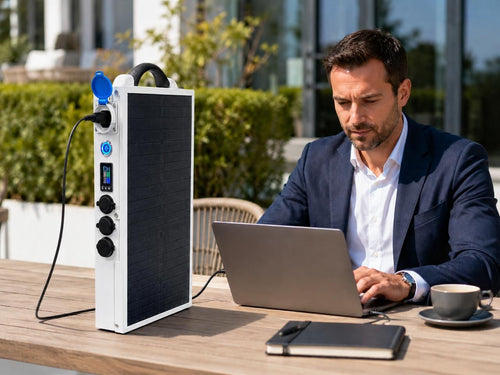
A Portable Power Station is suitable when loads are mobile, modest and located near one working area. Potential applications include:
- charging batteries and hand tools;
- laptops and tablets;
- measuring equipment;
- site inspections;
- temporary communication equipment;
- small cameras;
- LED task lighting;
- a mobile office;
- emergency backup.
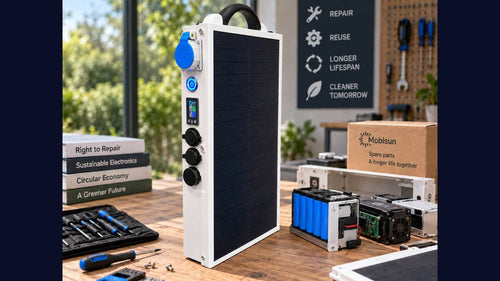
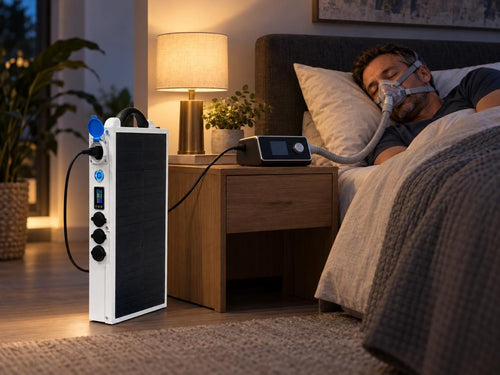
The Mobisun Portable Solar Generator provides a 3,000 Wh battery, 1,800 W continuous AC output and 3,600 W peak output. It is wheeled and can be charged through solar panels or mains electricity.
A portable system is appropriate when the continuous load remains below its output rating, the battery contains enough energy for the required period, solar panels or mains charging are available, three-phase power is not needed, and equipment can be distributed across separate smaller systems.
When Do You Need a Solar Trailer?
A Solar Trailer is suitable when the project requires substantially more energy than a Portable Power Station but the system must remain mobile. The Mobisun Solar Trailer combines:
- 20 kWh battery storage;
- 8 kWp solar capacity;
- 10 kVA backup generator;
- automatic solar tracking;
- mobile deployment on a trailer.
Mobisun states that the trailer can be made operational in approximately ten minutes by one person. It is intended for construction sites, events, telecom applications and backup power.
A trailer may be appropriate when the system moves between projects, cameras, lighting and site facilities run continuously, both 230 V and 400 V equipment is used, noise reduction is important, daily consumption is too high for a Portable Power Station, backup reliability is required, or quick deployment matters.
When Do You Need a 20ft Solar Container?
A containerised system becomes relevant when energy demand is higher, the installation will remain in place longer or the site needs a more infrastructure-like power supply. The Mobisun 20ft Solar Container is specified with:
- 50 kWh battery capacity;
- 13.3 kWp solar capacity;
- 22 kVA AC output;
- 20 kVA backup generator;
- remote monitoring;
- single- and three-phase outputs.
It is intended for off-grid locations, commercial sites and micro-grid applications.
Consider a 20ft container when several site facilities must be powered, a larger overnight load is present, three-phase output is required, the project is medium or long term, energy demand is relatively predictable, a secure and robust installation is needed, or the system may become part of a local micro-grid.
When Do You Need a 40ft Solar Container?
Large sites and industrial applications may require higher power and longer autonomy. The Mobisun 40ft Solar Container is specified with:
- 100 kWh battery capacity;
- 37.4 kWp solar capacity;
- 44 kVA AC output;
- 40 kVA backup generator;
- solar tracking;
- remote monitoring.
It is designed for larger commercial and industrial off-grid applications and micro-grids.
A 40ft system becomes relevant when multiple work zones need power, loads run simultaneously, daily energy use is high, the project requires a central energy hub, larger machinery or facilities are connected, longer energy autonomy is required, or the system must support significant three-phase loads.
Which System Does Your Construction Site Need?
| Site requirement | Suggested starting point |
|---|---|
| Laptops, chargers and small equipment | Portable Power Station |
| Small camera or monitoring installation | Portable Power Station with solar |
| Mobile teams and temporary task lighting | Portable Power Station |
| Multiple cameras, lighting and site cabins | Solar Trailer |
| Medium project with continuous day-and-night loads | Solar Trailer or 20ft container |
| Larger fixed project with three-phase demand | 20ft Solar Container |
| Large industrial or multi-zone project | 40ft Solar Container |
| Short project with unpredictable high loads | Rental diesel or hybrid solution |
| Long project with stable energy demand | Purchased or rented solar-hybrid system |
| Mission-critical supply | Solar, battery and automatic backup generator |
This table is only a first selection. Final sizing requires the complete load profile.
How to Calculate the Payback Period
Use: Payback period = additional net investment ÷ annual operating savings
Annual operating savings may include avoided diesel, reduced fuel deliveries, lower maintenance, fewer call-outs, lower rental costs, lower noise-control costs, avoided downtime and residual value. Subtract financing costs, battery degradation allowance, insurance, transport, remaining backup fuel and additional project-specific costs.
Illustrative example
Assume:
- additional investment in solar-battery capacity: €18,000;
- annual fuel savings: €6,300;
- annual maintenance and logistics savings: €1,200;
- annual additional system cost: €500.
Net annual savings: €6,300 + €1,200 − €500 = €7,000
Indicative payback: €18,000 ÷ €7,000 = approximately 2.6 years
Illustrative only
This is an illustrative calculation, not a quotation or guaranteed saving. The result changes considerably with diesel prices, generator consumption, solar yield, financing and system utilisation.
Questions to Ask Before Choosing
Before selecting a diesel generator, power station, trailer or container, document:
- What equipment will be powered?
- What is the rated wattage of each device?
- Which equipment operates simultaneously?
- Are there motors, pumps or compressors with startup peaks?
- How many hours per day does each load run?
- What remains active overnight?
- Is three-phase power required?
- How long will the project last?
- Can the panels remain free from shade?
- How many cloudy days of reserve are required?
- Is noise restricted at night?
- Is diesel delivery secure?
- Must the system move between sites?
- Is remote monitoring required?
- Is an automatic backup generator necessary?
The Strongest Solution Is Often Hybrid
The choice does not always have to be all-solar or all-diesel. A hybrid system can use:
- solar energy when available;
- stored battery energy during evenings and nights;
- a diesel generator only when demand or weather requires it.
This approach can reduce generator operating hours, fuel consumption, engine maintenance, noise, local emissions and dependence on fuel deliveries. At the same time, the backup generator provides additional resilience for high loads and extended periods of limited solar generation.
Strategic insight
For many professional construction sites, the goal is therefore not necessarily to eliminate the generator immediately. It is to stop running it when it is not needed.
Get a Construction-Site Energy Calculation
Choosing the right system starts with the load — not with the generator. Mobisun can assess daily energy consumption, maximum and peak power, overnight requirements, seasonal solar production, required battery reserve, recommended solar capacity, backup-generator requirements, expected diesel reduction and suitable system format.
Send us your equipment list and operating hours
Include equipment name, quantity, wattage, operating hours per day, night-time loads, peak or startup power, project location, project duration, available space and required connections. Request a project quote — we will calculate the required battery and solar capacity.
Frequently Asked Questions
Is a solar generator cheaper than a diesel generator?
A diesel generator often has a lower initial cost. A solar generator can have lower operating costs because it reduces fuel consumption and engine maintenance. The most economical option depends on project duration, energy use, diesel price and solar conditions.
Can a solar generator power construction tools?
Yes, provided the inverter can supply both the continuous wattage and startup peak of the tools. High-power equipment may require a larger trailer or container system.
Can solar power be used at night?
Yes. Solar energy generated during daylight is stored in the battery and used at night. Battery capacity must be sufficient for all overnight loads.
What is the best generator for construction-site cameras?
A solar-battery system is often well suited to cameras, routers, alarms and lighting because these systems require continuous power and frequently remain active overnight. The exact battery and panel size depends on total daily consumption.
What happens during cloudy weather?
Solar production decreases, but the battery can continue supplying electricity. Professional systems may include additional battery reserve, mains charging or an automatic backup generator.
Does a solar generator produce zero emissions?
It produces no local exhaust while supplying electricity from its battery. Lifecycle emissions still arise from manufacturing, transport and the source of charging electricity. A hybrid system produces local emissions whenever its backup diesel generator runs.
Is a Solar Trailer suitable for temporary projects?
Yes. A trailer is intended for mobile and temporary deployments where more energy is needed than a Portable Power Station can provide.
When is a solar container more suitable?
A container is more appropriate for longer projects, larger loads, three-phase equipment, several site facilities or a more permanent off-grid installation.
Can a solar generator replace diesel completely?
Sometimes. Complete replacement is more realistic when the load is predictable, solar conditions are suitable and sufficient battery reserve is installed. Sites with unpredictable high loads may be better served by a hybrid system.
How quickly can a solar system pay for itself?
Payback depends on the investment, avoided fuel use, maintenance savings and annual utilisation. A project-specific calculation is required.
Choose Your Construction-Site Power System
Three Power Tiers for Every Site
From mobile trailers to containerised energy hubs — find the system that matches your load profile and project duration.
Mobisun Solar Trailer
Mobile, multi-day projects
Wheeled trailer, ~10 min setup, 230V + 400V output
Best for: events, telecom, mid-size construction
→20ft Solar Container
Medium-term site power
3-phase output, larger battery, microgrid-ready
Best for: facilities, multiple loads, longer projects
→40ft Solar Container
Heavy off-grid energy hub
Max storage, industrial output, microgrid-capable
Best for: large industrial sites, permanent off-grid
→Conclusion: Solar or Diesel for Your Construction Site?
A diesel generator remains useful for short, peak-heavy or highly unpredictable projects. It can provide large amounts of power as long as fuel is available.
A solar generator or battery system becomes increasingly attractive when electricity is needed every day, cameras and lighting operate at night, fuel costs are significant, noise must be reduced, local emissions matter, the system will be reused, solar charging is available, or remote monitoring is required.
For small loads, a Portable Power Station may be sufficient. For mobile project power, a Solar Trailer provides more storage and output. For larger or longer-term construction sites, a 20ft or 40ft Solar Container can form a complete off-grid energy hub.
Ready to compare options?
The best system is not automatically the one with the largest battery or generator — it is the system designed around the actual load profile. Send us your equipment list and operating hours, and we will show whether a power station, Solar Trailer or Off-Grid Power Systems offers the strongest business case for your project.
Or use our large-system calculator to size your project.