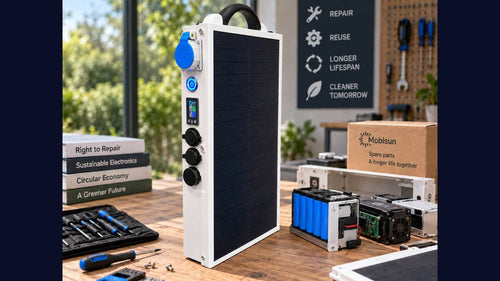

Choosing the right portable power station can seem complicated. Product specifications include watts, watt-hours, peak power, battery capacity and solar input — but which figures actually matter?
The answer depends on two main questions:
- What devices do you want to power?
- How long do you want to use them?
Battery capacity, measured in watt-hours (Wh), determines approximately how long your devices can run. Output power, measured in watts (W), determines whether the power station can operate those devices at all.
This guide shows you how to calculate exactly what size power station you need for camping, remote work, a campervan, emergency backup or professional use.
Shortcut
For a faster personalised estimate, use the Mobisun Runtime Calculator. Select a Mobisun system and the expected season to see estimated runtimes for smartphones, laptops, refrigerators, televisions, Wi-Fi routers, Starlink Mini, PoE equipment and LED lighting.
Quick Answer: What Size Power Station Do I Need?
As a general starting point:
| Required use | Recommended capacity |
|---|---|
| Phones, cameras and LED lights | 150–300 Wh |
| Laptop, router and small electronics | 250–500 Wh |
| Weekend camping with several devices | 300–700 Wh |
| CPAP machine overnight | 300–700 Wh |
| Small camping refrigerator | 500–1,000 Wh |
| Home emergency essentials | 500–1,500 Wh |
| Refrigerator or freezer for extended periods | 1,000–3,000 Wh |
| Coffee maker, kettle or power tools | 1,500 Wh or more, with sufficient output |
| Longer off-grid or professional use | 2,000–3,000 Wh or more |
These are broad recommendations. Your actual requirement depends on the power consumption and daily operating time of each device.
A 300 Wh power station may be ideal for charging laptops and phones, but far too small for running an electric heater. At the same time, a large battery is not useful when its inverter cannot deliver the starting power required by your appliance.
You therefore need to check both capacity and output power.
The Difference Between Watts and Watt-Hours
Understanding two measurements makes choosing a power station much easier.
Watts: what the power station can run
Watts indicate how much power a device uses at a particular moment.
| Device | Typical wattage |
|---|---|
| Smartphone charger | 10–30 W |
| Laptop | 30–100 W |
| Wi-Fi router | ~5–15 W |
| Television | ~30–100 W |
| Camping refrigerator | ~40–100 W |
| Coffee maker | ~600–1,500 W |
| Electric kettle | ~1,500–2,500 W |
The continuous output of the power station must be higher than the combined wattage of all devices you want to operate simultaneously.
Watt-hours: how long the power station can run
Watt-hours indicate how much energy the battery can store.
A 300 Wh battery can theoretically provide:
- 300 W for one hour
- 150 W for two hours
- 50 W for six hours
- 10 W for thirty hours
In practice, some energy is lost through the inverter, electronics, cables, temperature and battery management system.
Practical planning assumption
For planning purposes, Mobisun's Runtime Calculator uses approximately 85% usable battery capacity. A 308 Wh battery therefore provides approximately 262 Wh of usable energy.
Power Station Size Calculator — Step by Step
Use the following calculation to determine the battery capacity you need.
Step 1: Find the wattage of each device
Look at the product label, charger, manual or technical specifications.
When the label only shows volts and amps, calculate the power using:
Watts = volts × amps
For example: 12 V × 5 A = 60 W
For appliances with changing consumption, use the average operating wattage rather than only the maximum figure whenever possible.
Step 2: Estimate the number of operating hours
Write down how many hours per day you expect to use each device. A laptop may be used for six hours, while a refrigerator could run or cycle throughout the day.
Step 3: Calculate the energy consumption
Energy consumption in Wh = device wattage × operating hours
A 50 W laptop used for five hours requires: 50 W × 5 hours = 250 Wh
Step 4: Add all devices together
Example for a day of remote work:
| Device | Wattage | Use per day | Energy required |
|---|---|---|---|
| Laptop | 50 W | 5 hours | 250 Wh |
| Wi-Fi router | 5 W | 8 hours | 40 Wh |
| Smartphone | — | 1 full charge | 12 Wh |
| LED light | 10 W | 3 hours | 30 Wh |
| Total | 332 Wh |
Step 5: Account for conversion losses
Because the full nominal battery capacity is not available at the output, divide your energy requirement by 0.85:
Required battery capacity = total energy requirement ÷ 0.85
For the example above: 332 Wh ÷ 0.85 = 391 Wh
Step 6: Add a safety margin
Add at least 20% when:
- you may use devices longer than expected;
- temperatures could be low;
- the power station will be used regularly;
- you want reserve capacity;
- solar charging may be inconsistent;
- the appliance has variable consumption.
For the remote-work example: 391 Wh × 1.20 = 469 Wh
A power station of approximately 500 Wh would therefore be a sensible battery-only choice. A smaller power station may still work when it is recharged with a suitable solar panel while your devices are being used.
Simple Power Station Calculator Formula
Complete formula
Power station capacity (Wh) = total daily device consumption ÷ 0.85 × safety margin
- 1.1 for predictable, light use
- 1.2 for normal use
- 1.3 for emergency backup or uncertain conditions
Worked example
You want to run a 40 W device for eight hours:
40 W × 8 hours = 320 Wh
Allowing for efficiency: 320 Wh ÷ 0.85 = 376 Wh
Adding a 20% reserve: 376 Wh × 1.2 = 451 Wh
You should therefore choose a power station with approximately 450–500 Wh or more.
How Long Will a Power Station Last?
A quick battery-only runtime estimate is:
Runtime (hours) = usable battery capacity (Wh) ÷ device wattage (W)
The table below uses approximately 85% of the nominal battery capacity.
| Device | Typical consumption | 154 Wh battery | 259 Wh battery | 308 Wh battery |
|---|---|---|---|---|
| Wi-Fi router | 5 W | 26 hours | 44 hours | 52 hours |
| LED lighting | 10 W | 13 hours | 22 hours | 26 hours |
| Starlink Mini | 25 W | 5.2 hours | 8.8 hours | 10.5 hours |
| Television | 40 W | 3.3 hours | 5.5 hours | 6.5 hours |
| Laptop | 50 W | 2.6 hours | 4.4 hours | 5.2 hours |
| Refrigerator | 75 W | 1.7 hours | 2.9 hours | 3.5 hours |
Actual runtime may differ because of appliance cycling, startup surges, inverter efficiency, battery temperature, battery age, cable losses, simultaneous device use and the selected AC, DC or USB output.
A refrigerator, for example, may not continuously use its rated wattage — its compressor switches on and off. Measuring actual consumption with an energy meter provides a more reliable result.
Skip the manual calculation
The Mobisun Runtime Calculator shows estimated runtimes for your devices across summer, winter and cloudy conditions — for every Mobisun power station, with or without a solar panel.
Open the Runtime CalculatorWhat Size Power Station Do I Need for a Laptop?
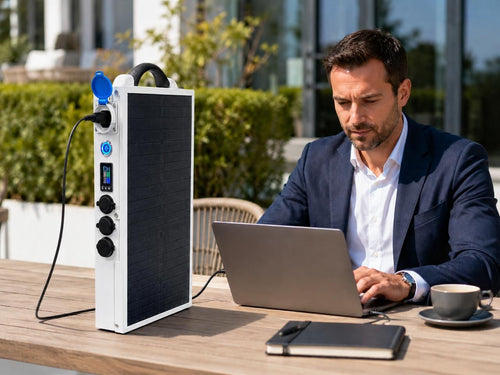
Most laptops consume approximately 30–100 W while operating. Charging requirements depend on the model, screen brightness, processor load and USB-C charger.
For one or two laptop charges, a power station of approximately 150–300 Wh may be sufficient. For a full working day with a laptop, phone and internet connection, calculate the complete setup.
| Device | Daily requirement |
|---|---|
| Laptop, 50 W for 6 hours | 300 Wh |
| Wi-Fi router, 5 W for 8 hours | 40 Wh |
| Smartphone | 12 Wh |
| LED light, 10 W for 2 hours | 20 Wh |
| Total consumption | 372 Wh |
After allowing for energy losses and reserve capacity, approximately 500–550 Wh would be advisable without solar charging.
For shorter working sessions, the Mobisun Pro Air provides 154 Wh capacity and 300 W continuous output in a portable format. For more demanding remote work, the Mobisun Pro Air 2.0 offers 308 Wh, 500 W continuous output, two 100 W USB-C PD ports and an IP67 waterproof enclosure. Adding the 100 W solar panel can significantly extend working time during daylight.
What Size Power Station Do I Need for Camping?
Camping requirements vary considerably. A basic setup (phones, lights, camera, occasional laptop) may require only 100–250 Wh per day. A complete setup (refrigerator, laptops, lighting, water pump, television, Starlink, several phones) can easily consume 500–1,500 Wh per day.
Light camping
Choose approximately 150–300 Wh when you mainly need to charge phones, cameras, lights and a laptop.
Weekend camping
Choose approximately 300–700 Wh, preferably with a solar panel, when you want to use several devices over multiple days.
Camping with a refrigerator
Start at approximately 500–1,000 Wh, depending on the refrigerator's measured average consumption and the availability of solar charging.
For a smaller, highly portable setup, the Mobisun Pro Air + 60 W bundle has 154 Wh battery capacity, 300 W continuous output and pass-through charging. For greater capacity and weather resistance, the Pro Air 2.0 + 100 W bundle provides 308 Wh, 500 W continuous output and IP67 protection.
For a broader overview of power stations in campers and caravans, see our camper & caravan guide.
What Size Power Station Do I Need for a Refrigerator?
First determine the refrigerator's actual average power consumption. A refrigerator may display a rated wattage of 75 W but does not necessarily consume 75 W continuously. The compressor cycles on and off depending on ambient temperature, insulation, thermostat setting, how often the door is opened, whether the refrigerator is already cold, and the amount of food inside.
Conservative calculation
For a refrigerator drawing 75 W continuously for 8 hours:
75 W × 8 hours = 600 Wh
After efficiency losses: 600 Wh ÷ 0.85 = 706 Wh
Adding a 20% reserve: 706 Wh × 1.2 = 847 Wh
You would need approximately 850 Wh for eight hours of continuous operation.
Based on measured average use
Suppose an energy meter shows an average consumption of only 30 W:
30 W × 8 hours ÷ 0.85 × 1.2 = 339 Wh
A power station of approximately 350 Wh or more may then be sufficient.
Startup surge
Always check the refrigerator's startup surge. The inverter must be able to supply the temporary peak when the compressor starts — often 2–4× the rated running wattage.
What Size Power Station Do I Need for a Power Outage?
Start by identifying the appliances that are truly essential. A basic emergency setup may include the Wi-Fi router, smartphones, LED lighting, radio, laptop and small medical or communication equipment.
| Essential device | Daily energy |
|---|---|
| Wi-Fi router, 5 W for 24 hours | 120 Wh |
| LED light, 10 W for 5 hours | 50 Wh |
| Two smartphone charges | 24 Wh |
| Radio, 5 W for 4 hours | 20 Wh |
| Total | 214 Wh |
After losses and a 20% reserve: 214 Wh ÷ 0.85 × 1.2 = 302 Wh
A power station of approximately 300 Wh would cover this basic example for about one day.
The Mobisun Pro Air 2.0 has a nominal capacity of 308 Wh, approximately 262 Wh usable, 500 W continuous output and 1,000 W peak output. It is suited to essential electronics, communication equipment, laptops and lighting. For a refrigerator, freezer or longer outage, the Mobisun Portable Solar Generator provides 3,000 Wh battery capacity, 1,800 W continuous AC output and 3,600 W peak output.
For a complete walkthrough of backup power at home, see our home backup power guide.
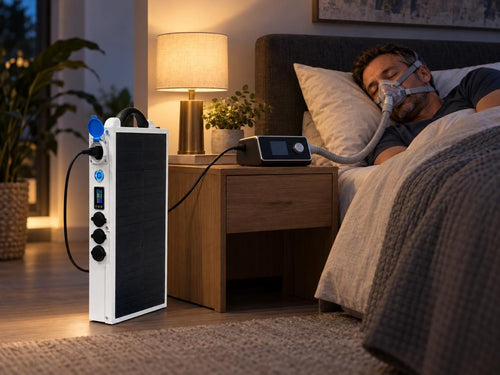
What Size Power Station Do I Need for a CPAP Machine?
CPAP consumption varies by model and settings. A humidifier or heated hose can considerably increase energy use.
Example without a heated humidifier: 40 W × 8 hours ÷ 0.85 × 1.2 = 452 Wh — start around 450–500 Wh.
If the machine averages 25 W: 25 W × 8 hours ÷ 0.85 × 1.2 = 282 Wh — around 300 Wh may be sufficient.
Before relying on a power station for medical equipment
- verify the machine's actual consumption;
- check whether direct DC operation is possible;
- test the complete setup at home;
- keep sufficient reserve capacity;
- consult the equipment manufacturer where necessary.
Capacity Is Not Enough: Check Continuous and Peak Output
A power station may contain enough energy but still be unable to start an appliance. Check two output ratings.
Continuous output
The amount of power the station can deliver continuously. A 500 W power station should not be used to operate an appliance that continuously requires 700 W.
Peak or surge output
Motors, pumps, refrigerators and some power tools briefly require extra power when starting. A refrigerator that normally uses 75 W might temporarily require several times that amount when its compressor starts. The power station's peak output must be able to handle this surge.
How to calculate the required output wattage
| Device | Running power |
|---|---|
| Laptop | 65 W |
| External monitor | 30 W |
| Wi-Fi router | 5 W |
| Lighting | 10 W |
| Combined consumption | 110 W |
A 300 W power station provides sufficient continuous output for this setup. However, combining a 900 W coffee maker with the same devices would increase consumption to approximately 1,010 W — a 300 W or 500 W power station could not operate that combination. Allow a power margin rather than continuously operating the inverter at its absolute limit.
Mobisun Power Station Comparison
| Mobisun model | Battery | Usable (≈85%) | Continuous | Peak |
|---|---|---|---|---|
| Pro Air | 154 Wh | 131 Wh | 300 W | 600 W |
| Pro Classic | 259 Wh | 220 Wh | 300 W | 500 W |
| Pro Air 2.0 | 308 Wh | 262 Wh | 500 W | 1,000 W |
| Portable Solar Generator | 3,000 Wh | ≈2,550 Wh | 1,800 W | 3,600 W |
The Pro Air uses a 154 Wh LiFePO₄ battery and provides 300 W continuous output. The Pro Classic increases capacity to 259 Wh while retaining a 300 W output. The Pro Air 2.0 combines 308 Wh with 500 W continuous output, IP67 protection and a fully modular, repairable design. The 3,000 Wh Portable Solar Generator is a larger wheeled system intended for longer-duration and higher-power applications.
Which Mobisun Power Station Should You Choose?
Choose the Mobisun Pro Air when:
- low weight and portability are priorities;
- you mainly charge phones, cameras and laptops;
- you use LED lighting or small electronics;
- you want a compact emergency power source;
- your connected equipment remains below 300 W.
Choose the Mobisun Pro Classic when:
- you need more battery capacity than the Pro Air;
- your devices remain below 300 W;
- runtime is more important than USB-C fast charging;
- you want to power several smaller devices.
Choose the Mobisun Pro Air 2.0 when:
- you need up to 500 W continuous power;
- you use high-power USB-C laptops or equipment;
- water and dust resistance are important;
- you want a fully repairable power station;
- you need a stronger emergency or remote-work solution;
- you want to combine it with a 100 W solar panel.
Choose the 3,000 Wh Portable Solar Generator when:
- you need to run refrigeration for longer periods;
- you need more than one day of backup power;
- you want to operate heavier appliances;
- you need up to 1,800 W continuous AC output;
- portability is less important than capacity.
How Much Solar Power Do You Need?
A solar panel does not increase the battery capacity. It produces new energy during daylight and can therefore extend your off-grid operating time.
A simple estimate is:
Daily solar production = panel wattage × effective sun hours
A 100 W panel receiving five effective sun hours could theoretically generate 100 W × 5 hours = 500 Wh.
Actual production may be lower because of clouds, shade, panel angle, high temperature, dirt, cable losses, charging-controller efficiency and changing sunlight throughout the day.
Seasonal realism
The Mobisun Runtime Calculator applies different effective-sun-hour assumptions for summer, spring or autumn, winter and cloudy weather. This provides a more realistic seasonal comparison than assuming maximum panel output throughout every day.
Can a Smaller Power Station Be Enough with Solar?
Yes, provided the solar panel generates enough energy during the day.
Suppose your devices consume 350 Wh per day and your power station stores only 308 Wh. Without recharging, the battery is too small. However, a 100 W panel may generate additional energy during daylight. When daily solar production exceeds your daily consumption, the system can potentially remain operational for much longer.
You should still allow reserve capacity for cloudy days, overnight use, poor panel positioning, seasonal reductions and unexpected additional consumption. For reliable off-grid operation, size the battery for the hours without sunlight and size the solar array for your average daily consumption.
Common Mistakes When Choosing a Power Station
- Looking only at battery capacity — a large battery with insufficient output cannot operate a high-wattage appliance.
- Looking only at inverter output — a 2,000 W inverter does not mean the battery can provide 2,000 W for several hours; capacity still determines runtime.
- Using maximum wattage as average consumption — some appliances cycle or change consumption; measure real energy use where possible.
- Ignoring startup power — refrigerators, pumps and tools may require a much higher temporary starting current.
- Assuming all nominal capacity is usable — conversion losses mean that usable output is lower than the capacity printed on the battery.
- Overestimating solar production — a 100 W panel rarely produces exactly 100 W continuously throughout the day.
- Forgetting simultaneous loads — add together all appliances that may operate at the same time.
- Choosing exactly the calculated minimum — a modest reserve protects against longer usage, battery ageing and changing conditions.
Power Station Buying Checklist
Before buying, answer these questions:
- Which devices will I connect?
- What is their combined continuous wattage?
- Do any devices have a startup surge?
- How many hours will each device operate?
- How many Wh will I consume per day?
- Do I need one day or several days of autonomy?
- Will I have access to solar charging?
- In which season will I use the system?
- How important are weight and portability?
- Do I need USB-C, 12 V or 230 V output?
- Will the power station be exposed to rain or dust?
- How much reserve capacity do I want?
Once you know these answers, use the Mobisun Runtime Calculator to compare the available Mobisun systems and seasonal solar performance.
Frequently Asked Questions
Is a 300 Wh power station enough?
A 300 Wh power station is suitable for phones, laptops, routers, lighting, cameras, Starlink Mini and other small electronics. It is usually too small for prolonged refrigerator use, electric heating, kettles, coffee makers or high-power cooking appliances.
How long will a 300 Wh power station run a 100 W device?
Assuming approximately 85% usable capacity: 300 Wh × 0.85 ÷ 100 W = 2.55 hours. Actual runtime may be shorter or longer depending on efficiency and device behaviour.
What size power station will run a refrigerator?
For several hours, start by considering approximately 500–1,000 Wh. For overnight or extended backup, 1,000–3,000 Wh may be more appropriate. Measure the refrigerator's actual average consumption and check its compressor startup power before choosing.
What size power station do I need for camping?
For phones, lights and occasional laptop charging, 150–300 Wh may be sufficient. For a refrigerator, multiple devices or a weekend without mains power, consider 500–1,000 Wh or combine a smaller station with suitable solar panels.
What size power station do I need for home backup?
For communication and lighting, approximately 300–500 Wh may cover basic short-term needs. For refrigeration, longer outages or multiple appliances, consider 1,000–3,000 Wh or more.
How many watt-hours do I need per day?
Multiply the wattage of every device by the number of hours it operates. Add the results together, divide by approximately 0.85 and add a 10–30% safety margin.
Is it better to buy a larger power station?
A larger battery provides more runtime and reserve capacity, but it also costs and weighs more. Choose sufficient capacity for your expected use rather than automatically buying the largest available system.
Can I use a power station while it is charging?
Mobisun Pro models support pass-through charging. This means you can power connected devices while the battery is being charged. Available solar energy, battery state and connected loads still determine whether the battery level rises or falls.
Does a 100 W solar panel always produce 100 W?
No. The rated output is measured under standard test conditions. Actual output depends on sunlight, temperature, orientation, shade, season and system losses.
How accurate is a power station runtime calculator?
A runtime calculator provides a useful estimate. Actual results depend on the real consumption of your device, startup surges, temperature, battery condition and conversion efficiency. For the most reliable result, measure your equipment's actual consumption and test the setup before relying on it.
Conclusion: What Size Power Station Do You Need?
To choose the right power station, check both:
- Wh capacity, which determines runtime;
- W output, which determines which devices can be powered.
Calculate your requirement by multiplying each device's wattage by its operating time. Add all energy use together, allow for conversion losses and include a safety margin.
For light portable use, 150–300 Wh may be sufficient. Remote work, camping refrigeration and emergency backup often require 300–1,000 Wh. Longer outages and heavier appliances may require 1,500–3,000 Wh or more.
The easiest next step is to compare your expected use with the Mobisun Runtime Calculator. Select a power station, solar-panel configuration and season to see how long your essential devices can operate.
Calculate your runtime, compare the Mobisun models and choose the portable energy system that fits your situation.